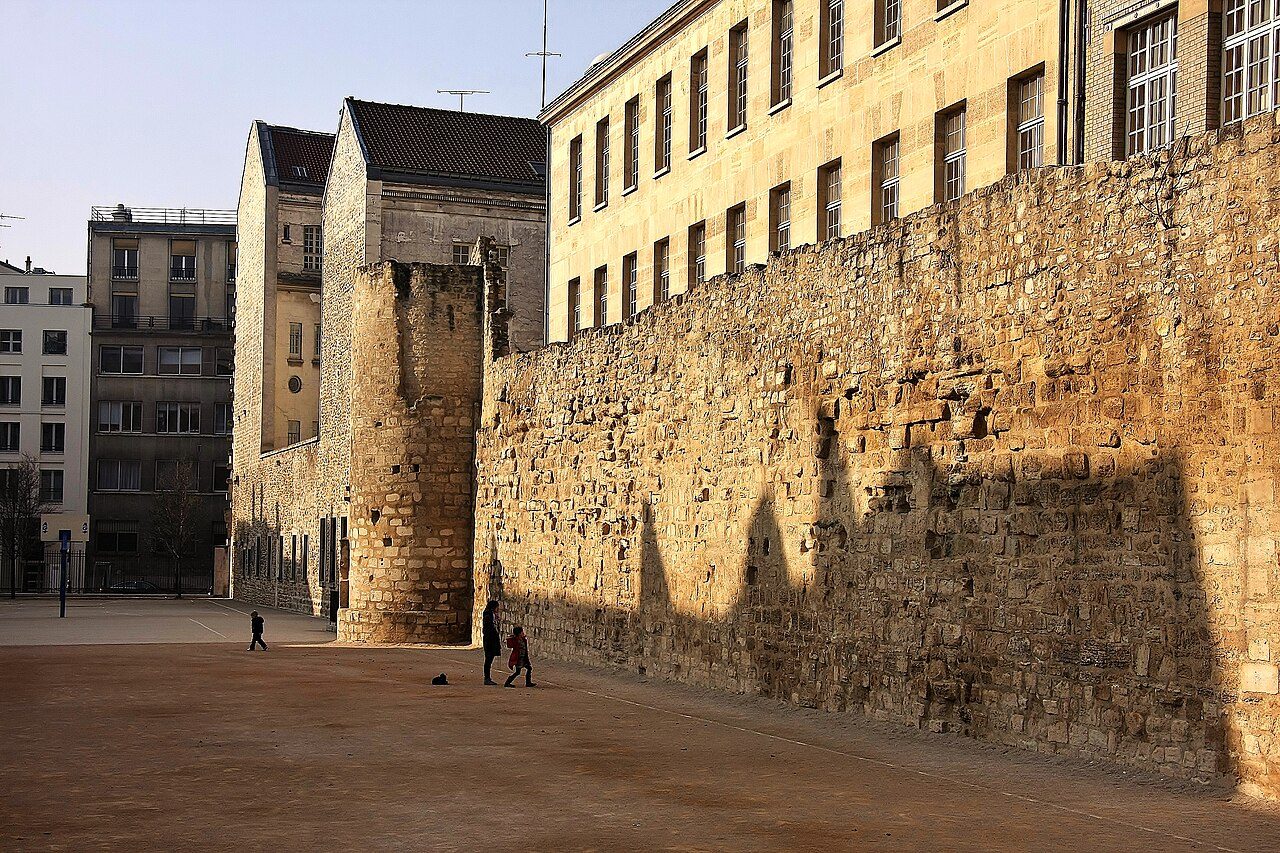
In 1190, before setting out on the Third Crusade, Philippe Auguste ordered Paris to be walled. The threat he had in mind was the Plantagenet king of England, who also held Normandy, an easy march from the city. The right bank, the busy merchant side, was enclosed first, by about 1209; the left bank, with its abbeys and schools, followed by around 1215. The two halves met the Seine at four great corner towers.
It was a serious piece of work: some five kilometres of wall in dressed limestone over a rubble core, six to eight metres high, with a round tower roughly every sixty metres, seventy-odd in all, and gates on the main roads. It enclosed about 250 hectares, room enough for gardens and vineyards as well as houses. It was never besieged. Within a century and a half the city had spilled beyond it, and Charles V built a new wall further out on the right bank; the old one was absorbed into houses, courtyards and cellars.
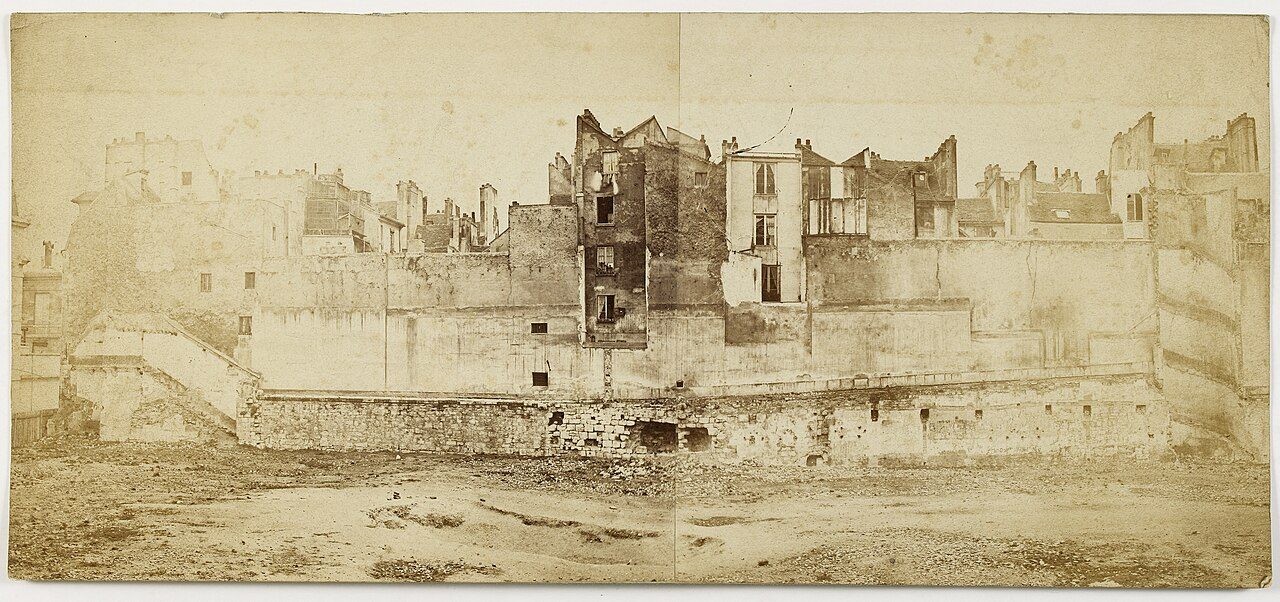
That absorption is why so much survives in pieces. The longest visible stretch, about sixty metres, stands on rue des Jardins-Saint-Paul, where the housing that had grown against it was pulled down after the Second World War as part of a slum-clearance programme. What remains is a high curtain wall running between two towers. At the corner of rue Charlemagne is a fragment of the tower that guarded the Saint-Paul postern, a small gate to the river; at the other end, a restored tower stands in a sports ground, where basketball is played against twelfth-century masonry.
Elsewhere the wall surfaces unexpectedly: a well-preserved section on rue Clovis beside the lycée Henri-IV, a tower base in the courtyard of the Crédit municipal on rue des Francs-Bourgeois, fragments in the Mazarine car park, and the foundations of the Louvre fortress that Philippe Auguste built just outside the wall, now visible beneath the museum. On the left bank, streets such as rue des Fossés-Saint-Bernard and rue Monsieur-le-Prince still follow its line.
What to look for
- The full height of the curtain wall from rue des Jardins-Saint-Paul, with the sports ground at its foot.
- The fragment of the Montgomery tower at the corner of rue Charlemagne, which once guarded the Saint-Paul postern.
- The regular courses of dressed stone on the outer face, and the rubble core where the facing has gone.
- The restored round tower at the far end of the sports ground.
Timeline
- 1190Philippe Auguste orders the wall before leaving on crusade
- c. 1209Right-bank wall completed (uncertain date)
- c. 1215Left-bank wall completed (uncertain date)
- 1889Surviving sections placed on the list of historic monuments
- 1946Houses against the wall on rue des Jardins-Saint-Paul demolished, exposing the stretch (uncertain date)
Plaques within 250 m
- 13 Rue Charlemagne · 60 m
ENCEINTE DE PHILIPPE AUGUSTE / RESTES DE LA TOUR MONTGOMERY DE LA POTERNE SAINT-PAUL, CONSTRUITE à LA FIN DU XII.e SIECLE.
- 28 Quai Des Célestins · 140 m
François Rabelais né à Chinon est mort dans une maison de la rue des Jardins Saint-Paul le 9 avril 1553
- 2 Rue Du Roi De Sicile · 190 m
Ici était l'entrée de la prison de la Grande Force (1782-1845). A cet endroit 161 détenus, dont la princesse de Lamballe, furent mis à mort les 3, 4, 5 septembre 1792
- 5 Rue De Sevigne · 190 m
DANS CETTE MAISON/ FRANCOIS-VINCENT/ RASPAIL/ PROMOTEUR DU SUFFRAGE UNIVERSEL / NÉ À CARPENTRAS / LE 24 JANVIER 1794/ MORT À ARCUEIL / LE 7 JANVIER 1878 / DONNA GRATUITEMENT /SES SOINS AUX MALADES / DE 1840 À 1848
- 12 Rue De Rivoli · 220 m
Bombardement / du / 12 avril 1918 / Torpilles allemandes / 27 morts - 72 blessés /1924
- 4 Quai Des Celestins · 220 m
ANTOINE LOUIS BARYE / SCULPTEUR / NÉ À PARIS / LE 24 SEPTEMBRE1795 / EST MORT / DANS CETTE MAISON / LE 25 JUIN 1875
- 16 Rue Beautreillis · 240 m
VICTORIEN SARDOU / AUTEUR DRAMATIQUE / EST NÉ DANS CETTE MAISON / LE 5 SEPTEMBRE 1831
- 1v Pont Marie · 250 m
Pont Marie / construit sous le / règne de Louis XIII / 1614-1636
Commemorative plaques, Ville de Paris open data (ODbL); transcriptions as published, in French.
Sources
- Ville de Paris: Sur les traces du Paris médiéval
- POP / Mérimée: Enceinte de Philippe-Auguste (PA00086265)
- Wikipédia: Enceinte de Philippe Auguste
- Wikipedia: Wall of Philip II Augustus
- Paris ZigZag: Les vestiges de l’enceinte de Philippe Auguste
- Wikidata Q3053741 (coordinates, CC0)
- Base Mérimée PA00085801