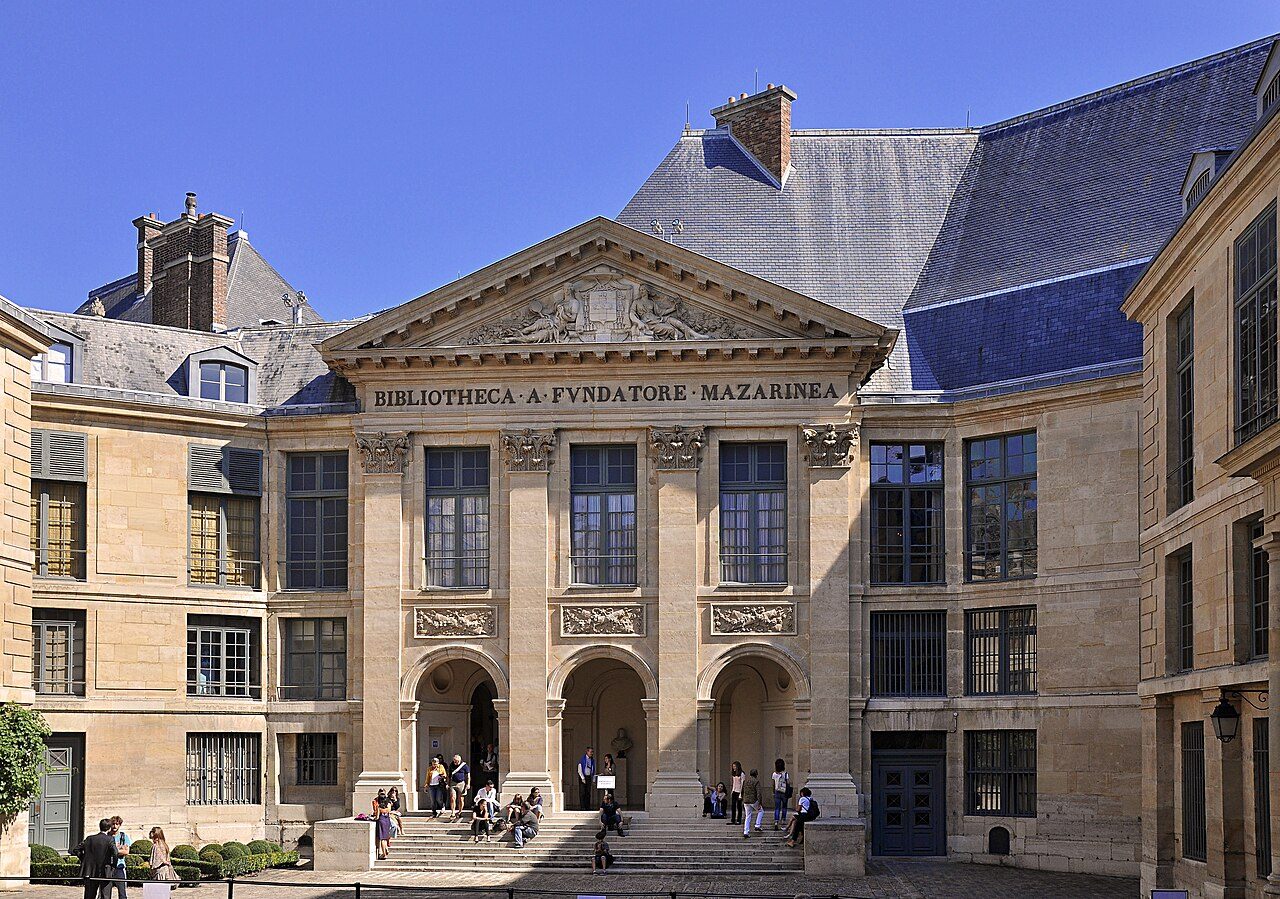
In 1643, the year he became Louis XIV’s chief minister, Cardinal Mazarin opened his private library, in his mansion near the present rue de Richelieu, to outside scholars who came to study. The idea, and much of the collection, belonged to his librarian Gabriel Naudé, who in 1627 had written the first modern treatise on how to build a library and who scoured Europe for books. By the late 1640s it held some 40,000 volumes. The library itself describes itself today as the oldest public library in France.
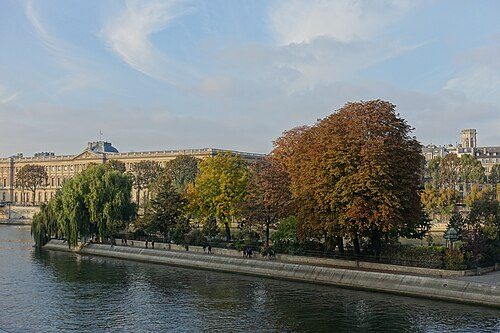
Then came the Fronde. Mazarin fled Paris, Parliament seized his goods, and early in 1652 the library was sold off at auction; Naudé managed to buy back only part of it before he died. Mazarin, back in power, rebuilt the collection and, shortly before his death in 1661, left it to the Collège des Quatre-Nations, the college he founded for students from provinces recently joined to France. Louis Le Vau designed the college on the left bank facing the Louvre, and the library moved into it, reopening to readers in 1689.
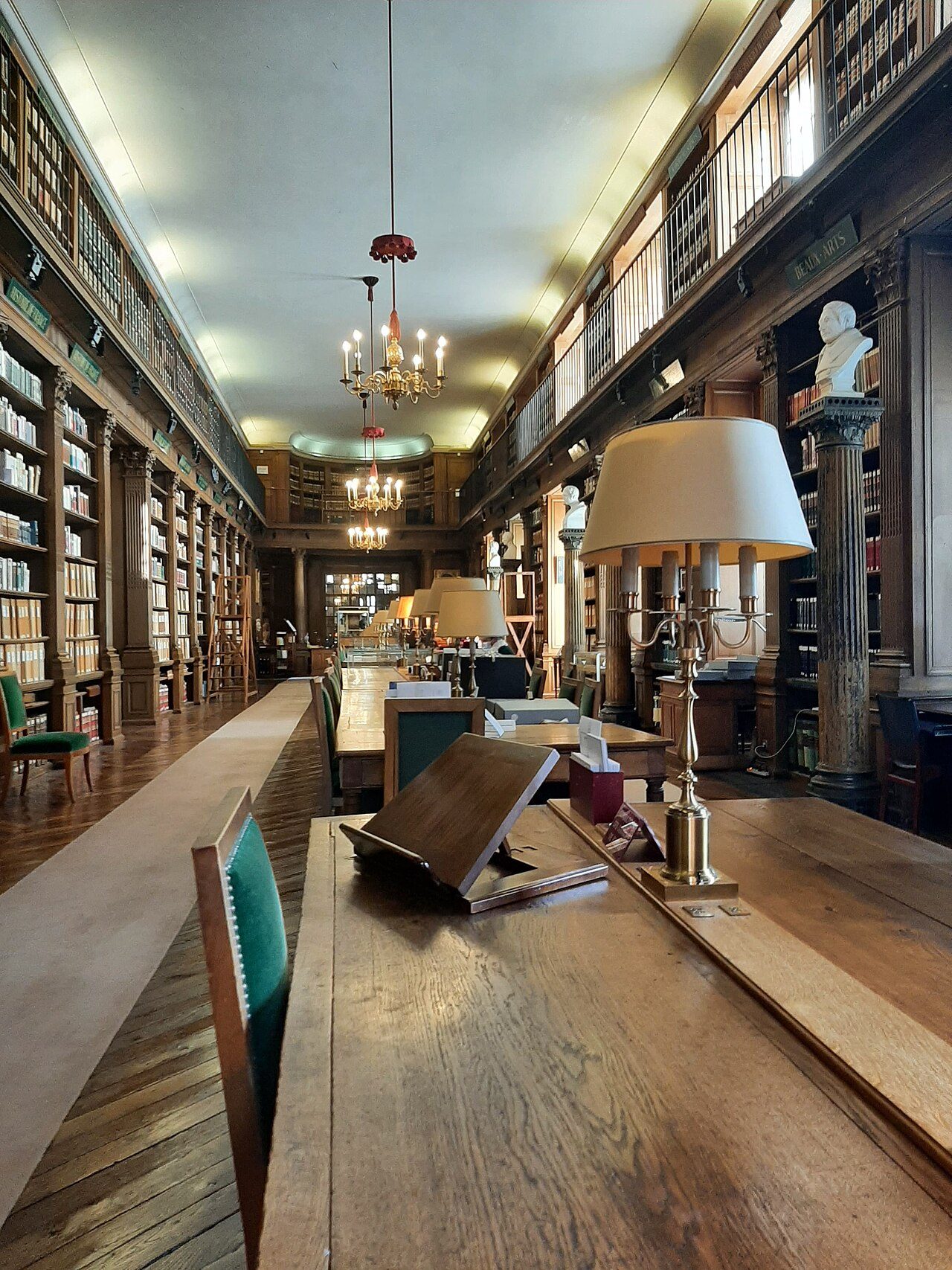
The woodwork came with it. The fluted columns, the shelving and the panelling carved with Mazarin’s arms were taken from the old gallery and refitted into two long rooms meeting at a right angle. Through the Revolution, which abolished the college, the library stayed open and grew, filled with books confiscated from abbeys and émigrés. Since 1805 the buildings have housed the Institut de France, to which the library was formally attached in 1945.
It is still a research library, with around 600,000 volumes, thousands of manuscripts and a famous copy of the Gutenberg Bible, and its reading room is also its showpiece: marble busts on the shelves, a celestial globe by Coronelli dated 1693, gilt-bronze chandeliers once owned by Madame de Pompadour, and silence.
What to look for
- The fluted columns and carved panelling brought from Mazarin’s first library.
- Coronelli’s celestial globe of 1693.
- The busts of Roman emperors, ancient authors and early modern scholars along the shelves.
- The oval staircase of 1824, lit from above, that leads up to the gallery.
Timeline
- 1643Mazarin opens his library to scholars
- 1652The library is sold at auction during the Fronde
- 1661Mazarin dies, leaving the rebuilt library to the Collège des Quatre-Nations
- 1689Reopening in Le Vau’s college building
- 1805The Institut de France moves into the former college
- 1945The library is attached to the Institut de France
Plaques within 250 m
- 23 Quai De Conti · 30 m
INSTITUT DE FRANCE / ACADÉMIE FRANÇAISE / ACADÉMIE DES INSCRIPTIONS / ET BELLES-LETTRES / ACADÉMIE DES SCIENCES / ACADÉMIE DES BEAUX ART / ACADÉMIE DES SCIENCES MORALES / ET POLITIQUES / ANCIENNEMENT / COLLÈGE DES QUATRE NATIONS / FONDÉ PAR LE CARDINAL MAZARIN / L'EDIFICEFUT ELEVE EN 1662 SUR LES PLANS DE LE VAU, ARCHITECTE
- 23 Quai De Conti · 30 m
INSTITUT DE FRANCE / BIBLIOTHÈQUE MAZARINE / FONDÉ EN 1643 / PAR LE CARDINAL MAZARIN / RATTACHÉE EN 1661 / AU COLLEGE DES QUATRE NATIONS / DEVENUE EN 1780 / PROPRIÉTÉ NATIONALE / LA BIBLIOTHÈQUE MAZARINE / EST LA PLUS ANCIENNE BIBLIOTHÈQUE PUBLIQUE DE FRANCE.
- 6 Rue De Seine · 40 m
DANS CETTE MAISON A VECU ET TRAVAILLE / DE 1775 A 1777 / ROGER JOSEPH BOSCOVICH / PHILOSOPHE, MATHEMATICIEN ET ASTRONOME / FONDATEUR DE L'ATOMISME MODERNE / NATIF DE DUBROVNIK CROATE DE NAISSANCE, FRANÇAIS D'ADOPTION / U OVOJ JE KU?I _x008e_IVIO I RADIO / OD 1775 DO 1777 / RUGJER JOSIP BOŠKOVI?
- Pont Des Arts · 70 m
A la mémoire de Vercors (Jean Bruller) co-fondateur en 1942 des Editions de Minuit avec le silence de la Mer et des Ouvriers du livre qui par leur dévouement, au péril de leur vie sous l'occupation nazie, ont permis à la pensée française de maintenir sa permanence et son honneur 1942-1992. 'Ce lieu du monde, unique et prestigieux, qui hantait ses pensées, nourissait ses rêves, exaltait son âme : le pont des Arts. Vercors. la Marche à l'Etoile'
- 3 Quai Malaquais · 80 m
ALEXANDER VON HUMBOLDT / 1769 1859 / NATURALISTE EXPLORATEUR HUMANISTE / MEMBRE DE L'INSTITUT / SEJOURNA A PARIS DE 1804 A 1827 / ET VECUT DANS CETTE MAISON
- 28 Rue Mazarine · 120 m
DANS CETTE MAISON OÙ IL HABITAIT / JEAN-FRANÇOIS CHAMPOLLION / DÉCOUVRAIT EN SEPTEMBRE 1822 / LE PRINCIPE DU DÉCHIFFREMENT / DES HIÉROGLYPHES ÉGYPTIENS
- 3 Rue Bonaparte · 130 m
EN 1837, / HONORÉ DE BALZAC / S'INSPIRA DU PARFUMEUR / JEAN VINCENT BULLY / ET DE SON OFFICINE / POUR SON ROMAN CÉSAR / BIROTTEAU
- 5 Rue Bonaparte · 130 m
ICI / ANCIENNEMENT / 5 RUE DES PETITS AUGUSTINS / NAQUIT / EDOUARD MANET / 1832 -1883
Commemorative plaques, Ville de Paris open data (ODbL); transcriptions as published, in French. 29 in all within this radius.
Sources
- Bibliothèque Mazarine: Histoire
- Bibliothèque Mazarine: Architecture et décor
- Bibliothèque Mazarine: Visiter la bibliothèque
- Histoire et civilisation du livre (Droz): article on Naudé and the Mazarine
- Sortir à Paris: the Bibliothèque Mazarine, the oldest public library in France
- Wikipedia: Bibliothèque Mazarine
- Wikidata Q774570 (coordinates, CC0)
- Base Mérimée PA00088652