The western point of the Île de la Cité did not always exist in this form. In the Middle Ages a few low islets sat in the river just beyond its tip. One of them, the île aux Juifs, took its grim name from executions carried out there. On 18 March 1314, Jacques de Molay, last Grand Master of the Knights Templar, and Geoffroi de Charney, a senior Templar, were burned alive on it, on the orders of Philip the Fair, after the long trial that destroyed their order. A plaque at the entrance to the square records it.
Legend says that from the pyre Molay summoned the king and Pope Clement V to answer before God within the year, and both did die in 1314. The story owes much to later chroniclers and to Maurice Druon, who opened his cycle of novels Les Rois maudits with it; there is no contemporary record of the curse.
The islets were joined to the Cité when the Pont Neuf was built across them. Begun under Henri III in 1578, stalled by the Wars of Religion and finished under Henri IV in the early 1600s, it was the first Paris bridge built without houses on it and with raised pavements for pedestrians. Behind it, the king laid out the place Dauphine. After his assassination in 1610, an equestrian statue of Henri IV was set up on the bridge; the Revolution melted it down in 1792, and the present one, by François-Frédéric Lemot, went up in 1818.
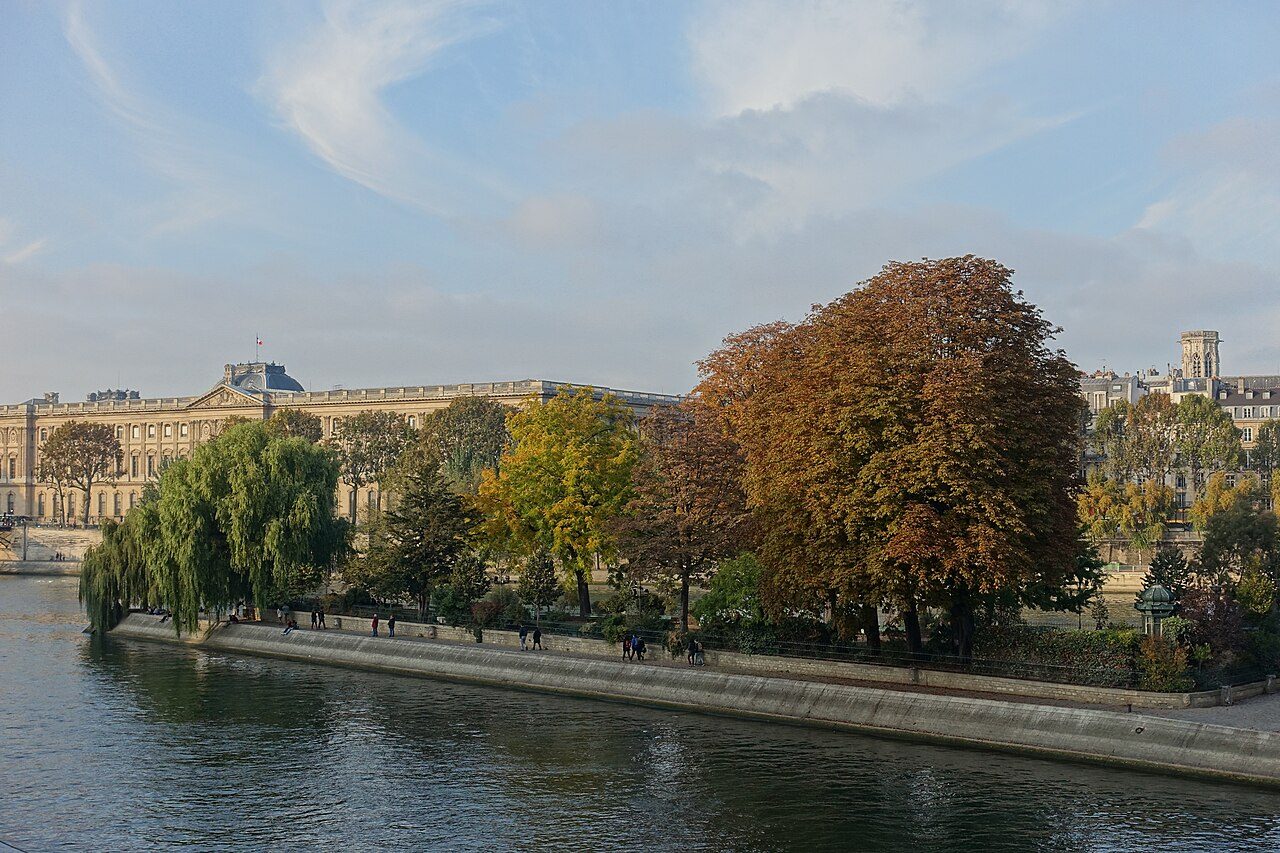
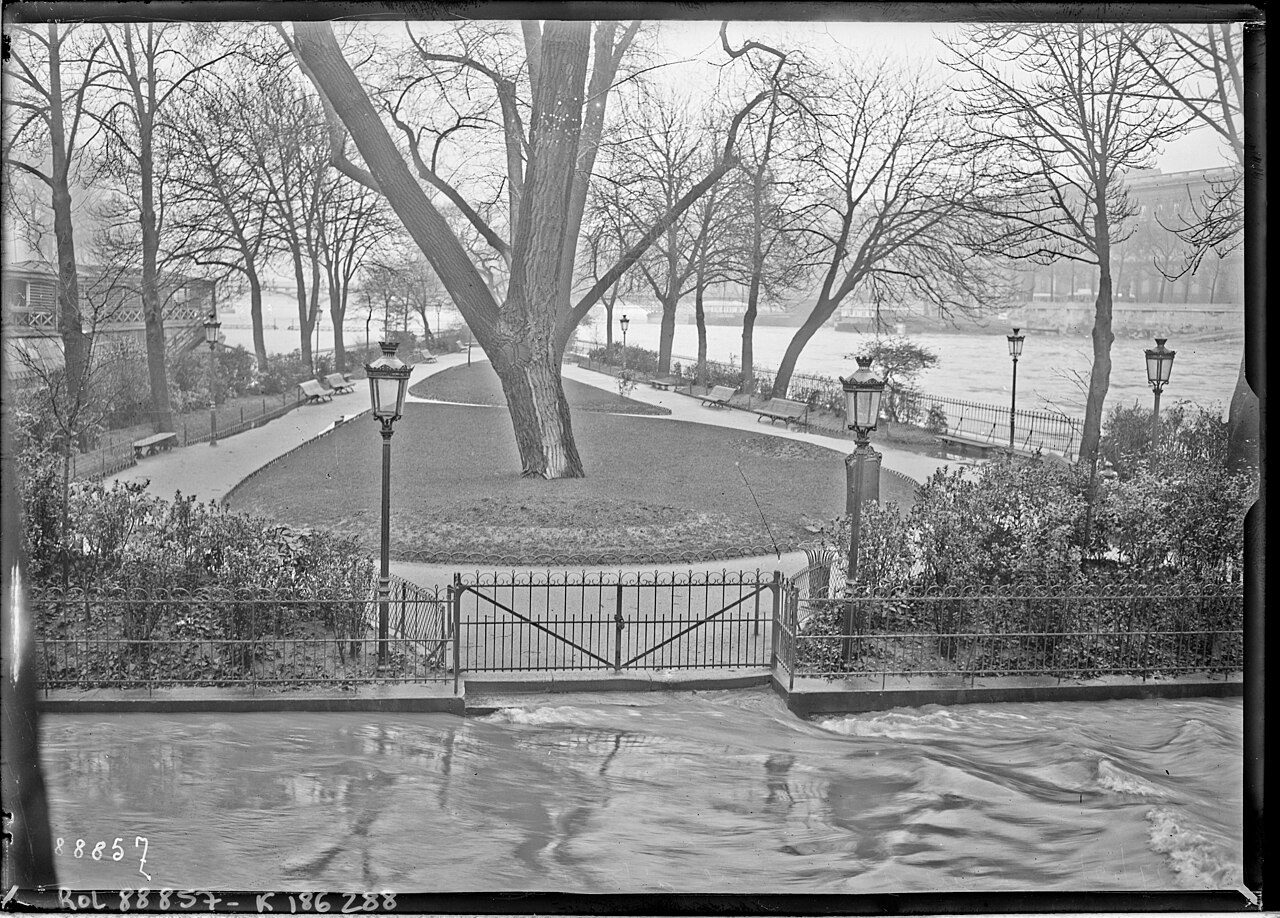
The garden below the statue was handed to the City in 1884 and named after the king’s nickname, the Vert-Galant, a tribute to his unflagging pursuit of women into middle age. It lies some seven metres below the level of the rest of the island, close to the water, so it goes under water when the Seine floods. The rest of the year it is a triangle of lawn and trees, with a weeping willow trailing its branches toward the river, where Parisians sit with their feet over the water and watch the boats turn.
What to look for
- The plaque recording the burning of Jacques de Molay on 18 March 1314.
- The weeping willow at the very point of the island.
- Lemot’s bronze Henri IV above the square, green with age.
- The carved stone masks along the cornice of the Pont Neuf, seen from below.
- The drop in level between the bridge and the garden, which explains why the square floods.
Timeline
- 1314Jacques de Molay burned on the île aux Juifs (18 March)
- 1578First stone of the Pont Neuf laid under Henri III
- 1607Pont Neuf inaugurated under Henri IV
- 1792First statue of Henri IV destroyed
- 1818Lemot’s statue installed
- 1884Land passed to the City and laid out as a square
Plaques within 250 m
- Pont Neuf · 60 m
LE 24 AOÛT 1572 ET LES JOURS SUIVANTS/ PARIS A ÉTÉ LE THÉÂTRE/ DU MASSACRE DE LA SAINT-BARTHÉLEMY./ APRÈS L'AMIRAL GASPARD DE COLIGNY, / PLUSIEURS MILLIERS DE PROTESTANTS FURENT ASSASSINÉS DU FAIT DE LEUR RELIGION/. Jour qui avec horreur parmi les jours se compte/Qui de marque de rouge, et rougit de sa honte/ AGRIPPA d'AUBIGNE, Les Tragiques
- Pont Neuf 1er Et 6e · 110 m
PONT NEUF COMMENCÉ SOUS HENRI IV LE GRAND 1578-1607
- 28 Rue Henri Robert · 140 m
ANDRÉ ANTOINE 1858-1943 COMÉDIEN FRANÇAIS CRÉATEUR DU THÉÂTRE LIBRE A VÉCU DANS CETTE MAISON DE 1912-1934
- 68 Quai Des Orfèvres · 150 m
ICI FUT DE 1948 À 1988 L'ILLUSTRE LIBRAIRIE ET MAISON D'ÉDITION MARTIN FLINKER ET KARL FLINKER DONT LES AMIS SE NOMMAIENT TH.MANN.R. MUSIL A.BROCH, H.HESSE, ST SWEIG, P.CELAN, ELUARD, QUENEAU ET C.
- 28 Quai Du Louvre · 180 m
ABDELKADER GUERMAZ/PEINTRE POETE CRITIQUE D'ART/A VECU DANS CETTE MAISON/DE 1962 A 1996
- 23 Quai De Conti · 200 m
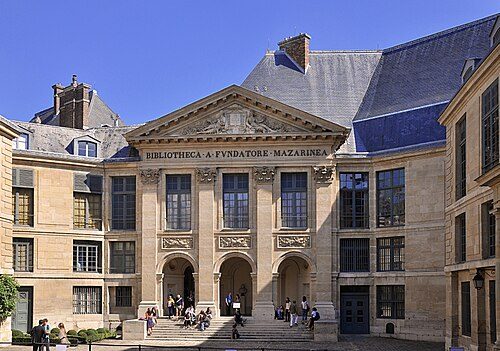
INSTITUT DE FRANCE / BIBLIOTHÈQUE MAZARINE / FONDÉ EN 1643 / PAR LE CARDINAL MAZARIN / RATTACHÉE EN 1661 / AU COLLEGE DES QUATRE NATIONS / DEVENUE EN 1780 / PROPRIÉTÉ NATIONALE / LA BIBLIOTHÈQUE MAZARINE / EST LA PLUS ANCIENNE BIBLIOTHÈQUE PUBLIQUE DE FRANCE.
- 3 Place Du Louvre · 200 m
SUR CET EMPLACEMENT S'ÉLEVAIT LA MAISON OÙ NAQUIT LE 2 SEPTEMBRE 1846 PAUL DÉROULÈDE POÈTE ET SOLDAT
- Pont Des Arts · 210 m
A la mémoire de Vercors (Jean Bruller) co-fondateur en 1942 des Editions de Minuit avec le silence de la Mer et des Ouvriers du livre qui par leur dévouement, au péril de leur vie sous l'occupation nazie, ont permis à la pensée française de maintenir sa permanence et son honneur 1942-1992. 'Ce lieu du monde, unique et prestigieux, qui hantait ses pensées, nourissait ses rêves, exaltait son âme : le pont des Arts. Vercors. la Marche à l'Etoile'
Commemorative plaques, Ville de Paris open data (ODbL); transcriptions as published, in French. 13 in all within this radius.