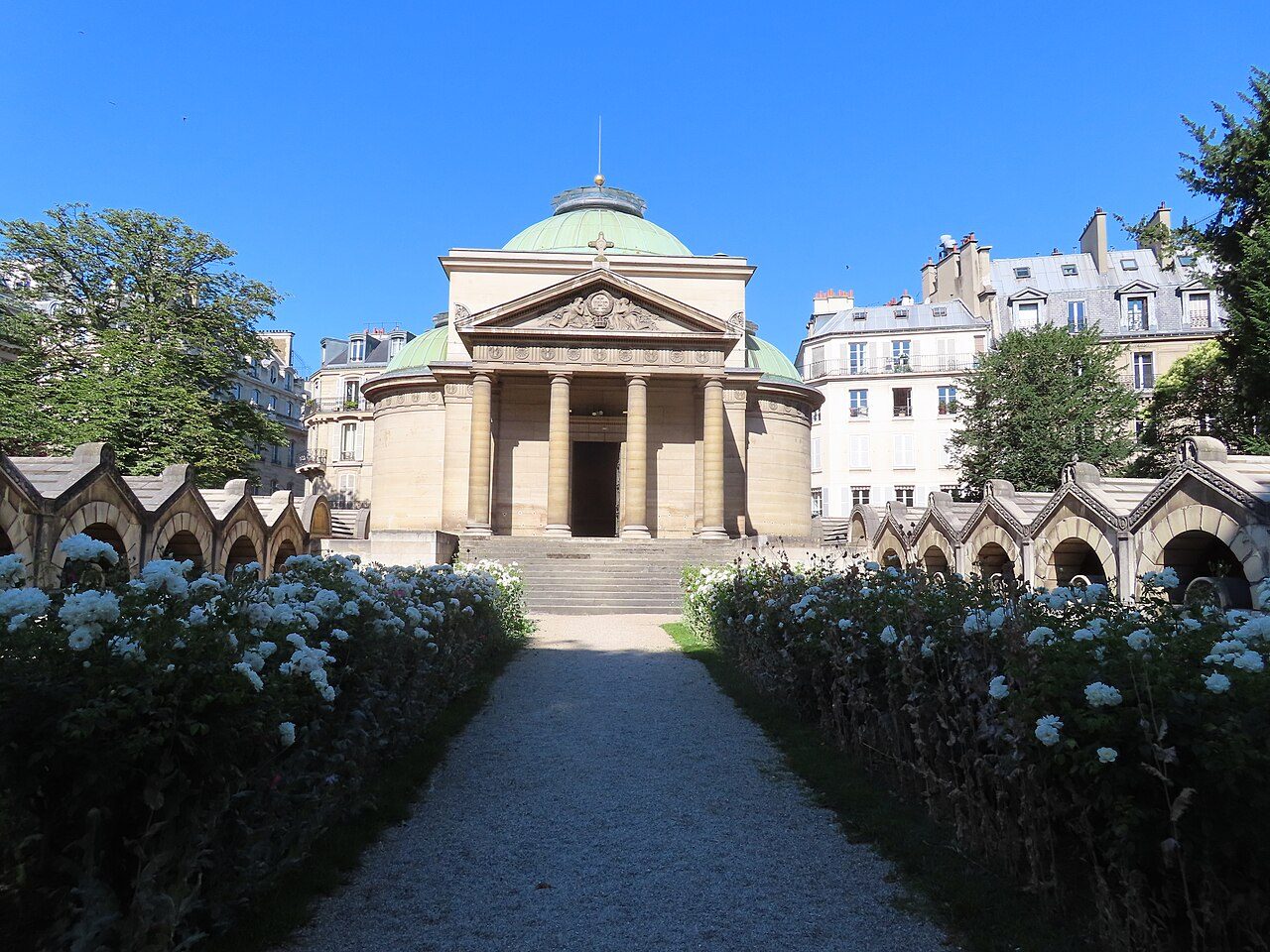
In 1722 the parish of the Madeleine opened a small cemetery off the rue d’Anjou. Its first great intake came in 1770, when a crush during the fireworks for the marriage of the future Louis XVI and Marie-Antoinette killed several hundred people on the place Louis XV; 133 of them were buried here. Twenty-two years later the same square, renamed place de la Révolution, held the guillotine, and the cemetery became a burial ground of the Revolution: Swiss Guards killed defending the Tuileries on 10 August 1792, then, from October 1792, the guillotined, among them Charlotte Corday, Madame du Barry, Olympe de Gouges, Madame Roland, Philippe Égalité, the Girondin deputies, some five hundred in all.
Louis XVI was buried here after his execution on 21 January 1793, in a pit of his own; Marie-Antoinette followed on 16 October. The cemetery was closed in March 1794 and later sold. In 1802 a royalist magistrate, Pierre-Louis Olivier Desclozeaux, bought it, opened it to visitors and marked the spot he believed held the royal graves.
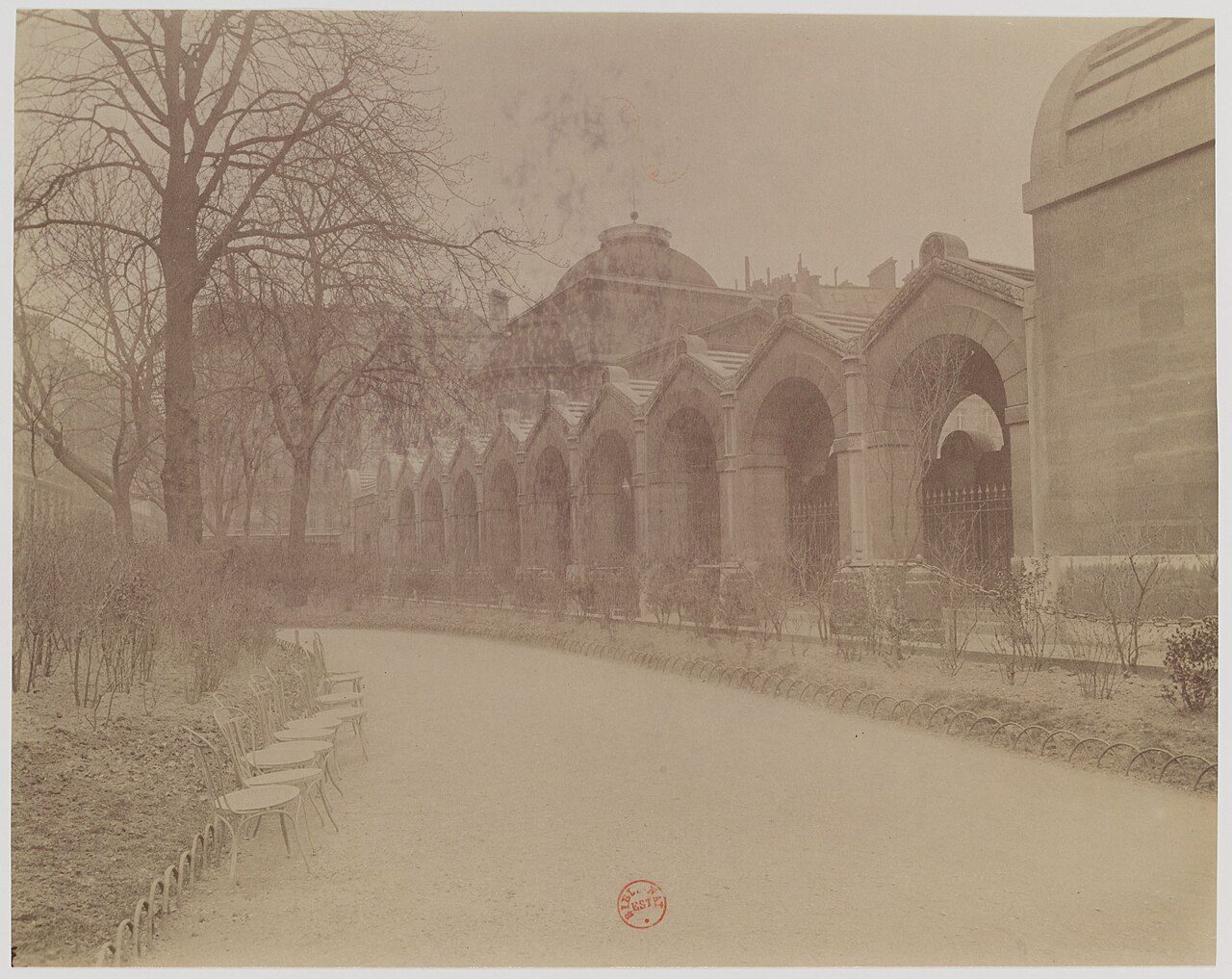
When the Bourbons returned, Louis XVIII bought the ground from him. Remains identified as those of the king and queen were exhumed and, on 21 January 1815, carried to the royal necropolis at Saint-Denis; the first stone of a chapel was laid the same day. Napoleon’s Hundred Days interrupted the work, which began in earnest in 1816 under Pierre Fontaine, Napoleon’s former architect, assisted by Louis-Hippolyte Lebas. Bones turned up in prodigious numbers as the foundations went in; Fontaine had them sealed in four ossuaries, whose location was then forgotten until cameras found them behind the walls of the lower chapel in 2018. The chapel was finished in 1826, a sober domed building behind a courtyard lined with cenotaphs.
It has never been loved by everyone. In May 1871 the Commune ordered it pulled down; according to the monument’s own history, a man posing as a rich American buyer delayed the work until the Commune fell; the Commission du Vieux Paris refused its demolition in 1903, and a last bill to remove it failed in 1910. It was classified as a historic monument in 1914 and is now in the care of the Centre des monuments nationaux. Inside, two marble groups face each other: Louis XVI raised by an angel, by François-Joseph Bosio, and Marie-Antoinette supported by Religion, by Jean-Pierre Cortot, with the king’s will and the queen’s last letter, known as her testament, inscribed below them.
What to look for
- The courtyard cenotaphs, recalling the Swiss Guards and the dead of the Revolution buried in the old cemetery.
- Bosio’s Louis XVI and Cortot’s Marie-Antoinette, facing each other in the nave.
- The texts of the king’s will and the queen’s last letter on the pedestals.
- The lower chapel, behind whose walls the ossuaries were found in 2018.
- The square Louis-XVI around it, laid out in 1862.
Timeline
- 1722The Madeleine cemetery opens
- 1793Louis XVI (21 January) and Marie-Antoinette (16 October) buried here
- 1794The cemetery closes in March
- 1815Royal remains taken to Saint-Denis on 21 January; first stone laid
- 1826The chapel is completed under Charles X
- 1914Classified as a historic monument
- 2018The four ossuaries are located behind the lower chapel walls
Plaques within 250 m
- 5b Rue De Greffulhe · 190 m
Dans cette / Maison a vécu / Georges HUGON / Compositeur (1904-1980) / DE 1967 à sa MORT
- 7 Rue De Greffulhe · 190 m
REYNALDO HAHN / Compositeur français / Membre de l'Institut / Directeur de l'Opéra / Commandeur / de la Légion d'Honneur / né le 9 août 1874 à Caracas / EST MORT DANS CETTE MAISON / le 28 janvier 1947
- 36 Rue Des Mathurins · 200 m
Geoges*et* / Ludmilla*Pitoeff* / ont*joué*dans*ce* / théâtre*entre* / MCMXXVII*et*MCMXXXIX*
- 2 Rue De Greffulhe · 230 m
Ugo Ugaro / Baryton de la Scala de Milan / a Habite cette maison / de juin 1970 à sa mort / le 4 décembre 1999
Commemorative plaques, Ville de Paris open data (ODbL); transcriptions as published, in French.