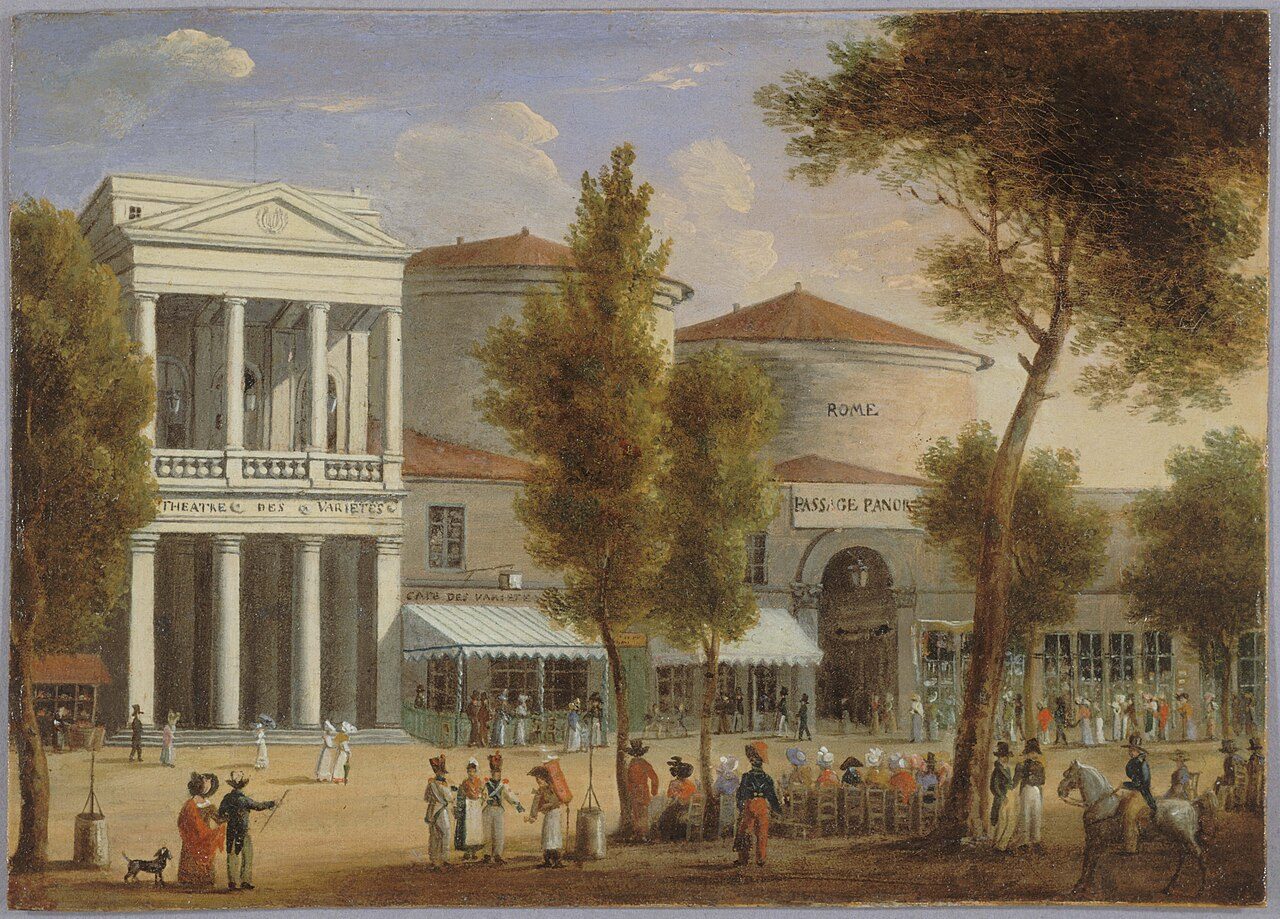
The name is a ghost. Around 1799–1800 an American, James Thayer, bought the old Hôtel de Montmorency-Luxembourg off the boulevard Montmartre and raised two tall rotundas at its boulevard end. Inside each hung a circular painted canvas: you climbed a dark stair, came out on a platform, and found yourself surrounded by Paris seen from the Tuileries, or by the evacuation of Toulon. The painter in charge was Pierre Prévost, the first French master of the form. Robert Fulton, then in Paris trying to sell Napoleon a submarine, had brought the panorama idea and its rights with him and is said to have used the proceeds for his inventions.
Between the two towers Thayer cut a lane of shops running south through the block, and Paris, which had no pavements worth the name, took to it at once. The Théâtre des Variétés opened alongside in 1807 and sent its crowds through. Around 1816–17 the passage became the first public place in the city to be lit by gas, a trial of an invention that would change the look of night in every European capital.
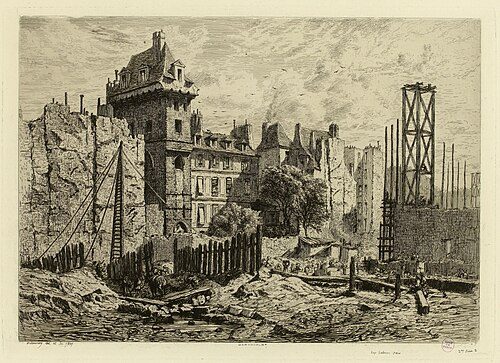
The rotundas came down in 1831, but the name stayed. In 1834 the architect Jean-Louis Grisart rebuilt the passage and threaded three secondary galleries through the block: Saint-Marc, Variétés (which still leads to the theatre’s stage door) and Feydeau-Montmartre. That same year an engraver opened at no. 47; under Moïse Stern and his heirs the shop engraved visiting cards and letterheads for the smart and the famous until the firm left in 2008, and its carved woodwork survives in what is now a café.
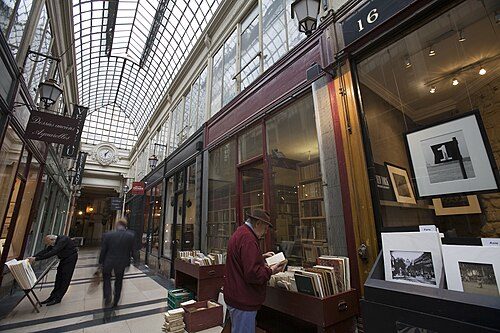
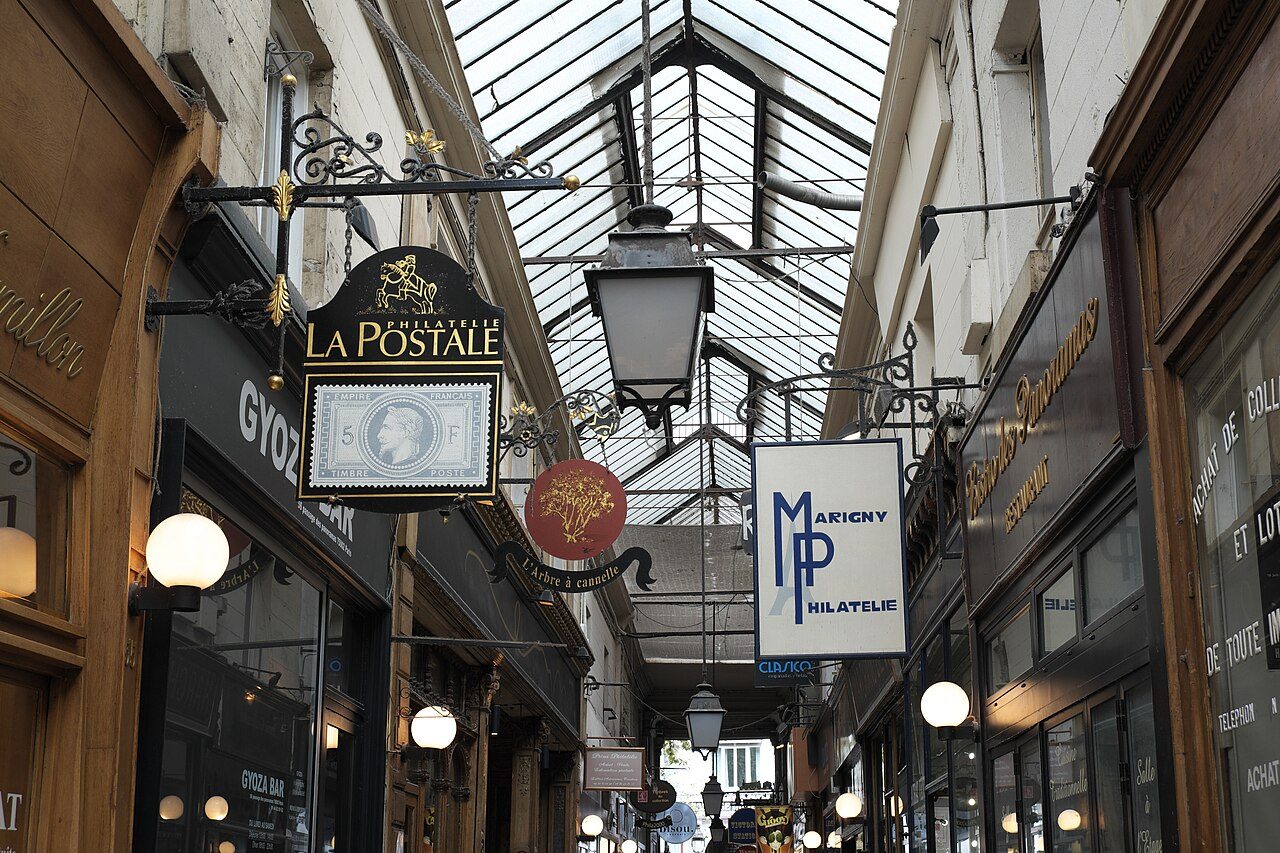
Zola walked Nana through here, among the cheap jewellery and the gaslight, in the novel set in 1867. Later came the stamp and postcard dealers who still give the passage its particular character. Listed as a historic monument in 1974, it remains the most crowded and least polished of the great passages, with a lived-in, slightly cluttered charm.
What to look for
- The former Stern engraver’s shop at no. 47, its carved wood fittings kept inside.
- The Galerie des Variétés and the stage door of the Théâtre des Variétés.
- Stamp and postcard dealers’ windows, a trade the passage has kept for more than a century.
- The rue Saint-Marc entrance, said to reuse the doorway of the old Montmorency-Luxembourg mansion.
Timeline
- 1799James Thayer opens the passage between two panorama rotundas (some sources say 1800) (uncertain date)
- 1807The Théâtre des Variétés opens next to the passage
- c. 1817First gas lighting in a Paris public place (uncertain date)
- 1831The rotundas are demolished
- 1834Jean-Louis Grisart remodels the passage and adds three galleries
- 1974Listed as a historic monument
Plaques within 250 m
- 27 Boulevard Poissonniere · 140 m
FREDERIC CHOPIN/ HABITA CETTE MAISON/ 1831-1832
- 12 Place De La Bourse · 150 m
NICOLAI GOGOL/ 1809-1852/ ÉCRIVAIN RUSSE/ A SEJOURNÉ DANS CETTE MAISON/ OU IL A TRAVAILLÉ A SON POÈME/ LES AMES MORTES
- 1 Rue Drouot · 160 m
ICI SE TROUVAIT/LE GOLF DROUOT/« TEMPLE DU ROCK »/FONDÉ PAR/HENRI LEPROUX/OÙ DE 1955 À 1981/SE FIRENT CONNAITRE DE NOMBREUX TALENTS/DE LA SCÈNE FRANÇAISE
- 4 Rue Rossini · 210 m
ICI / DÉCÉDAIT LE 7 MAI 1951 / LE POÈTE / ROBERT DE BÉDARIEUX
- 11 Rue De La Grange Bateliere · 220 m
Comte Félix de Jouffroy Gonsans / Promoteur du passage / 1844
- 146 Rue Montmartre · 230 m
ICI/ LE/ 31 JUILLET 1914/ JEAN JAURÈS/ FUT/ ASSASSINÉ// HOMMAGE DE LA LIGUE DES DROITS DE L'HOMME 1923
- 10 Rue De La Grange Bateliere · 240 m
EDIFIE SOUS LOUIS XV / HOTEL DE Mr. DE NOLIVOS CAPITAINE / AUX GARDES FRANCAISES SOUS LOUIS XVI / RESIDENCE DU MARQUIS DE LILLERS / CHAMBELLAN DE L'EMPEREUR NAPOLÉON Ier / CERCLE ROMANTIQUE DE Mr. TATTET / QUI RÉUNISSAIT VIGNY.MUSSET / ET VICTOR HUGO
Commemorative plaques, Ville de Paris open data (ODbL); transcriptions as published, in French.
Sources
- Ville de Paris: Découvrez la magie des galeries et passages couverts parisiens
- Paris je t’aime / Visit Paris Region: Passage des Panoramas
- Sotheby’s: The grandeur of Pierre Prévost’s Panorama of Paris
- Fondation Napoléon: Le panorama et l’épopée napoléonienne
- Wikipédia: Passage des Panoramas
- Wikidata Q3141829 (coordinates, CC0)
- Base Mérimée PA00086090