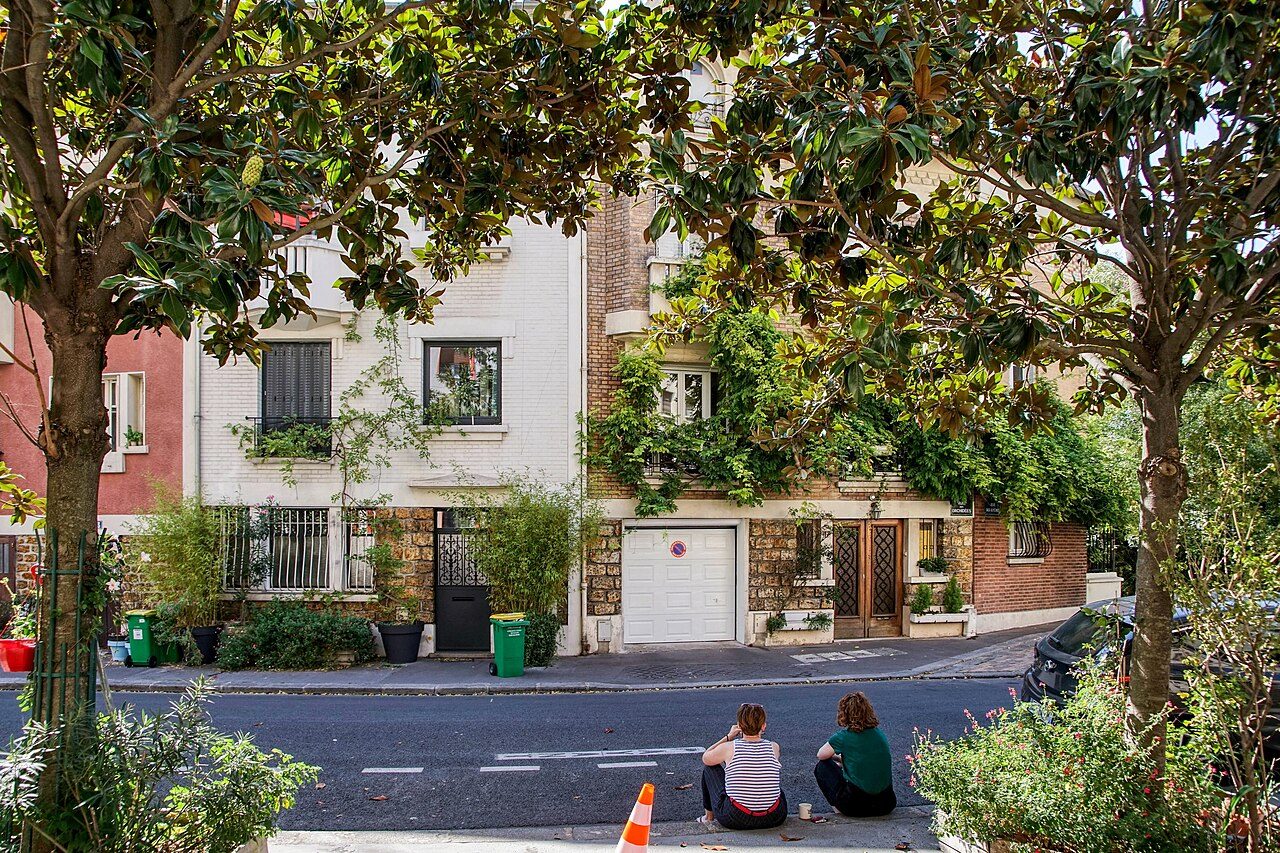
The Bièvre was the other river of Paris. It came in from the south-west, wound through the 13th arrondissement and joined the Seine near the Gare d’Austerlitz, and for centuries tanners, dyers and laundries lined its banks. In this low corner of its valley it spread into wet meadows and ponds between two arms of the stream. In winter the ponds froze, the ice was cut and stored in pits and old quarries on the heights nearby, and the trade gave the district its name: la Glacière.
From the 1860s the polluted river was progressively covered and buried, the last open stretches, the Glacière among them, disappearing in 1912; its valley was filled in, here to a considerable depth. Rue Brillat-Savarin, with its long curve, follows the course of the old stream. The made ground was cheap but soft, and builders were wary of putting heavy apartment blocks on it.
The Cité florale is the result. In the late 1920s, a triangular plot of the old meadow, bounded by rue Brillat-Savarin, rue Boussingault and rue Auguste-Lançon, was divided into small lots for individual houses, each with its own garden. About fifty were built, mostly two or three storeys, in brick and render, some with the geometric touches of the period. The lanes were paved and given the names of flowers and climbers: rue des Glycines, des Iris, des Liserons, des Orchidées, des Volubilis, and at the centre the square des Mimosas.
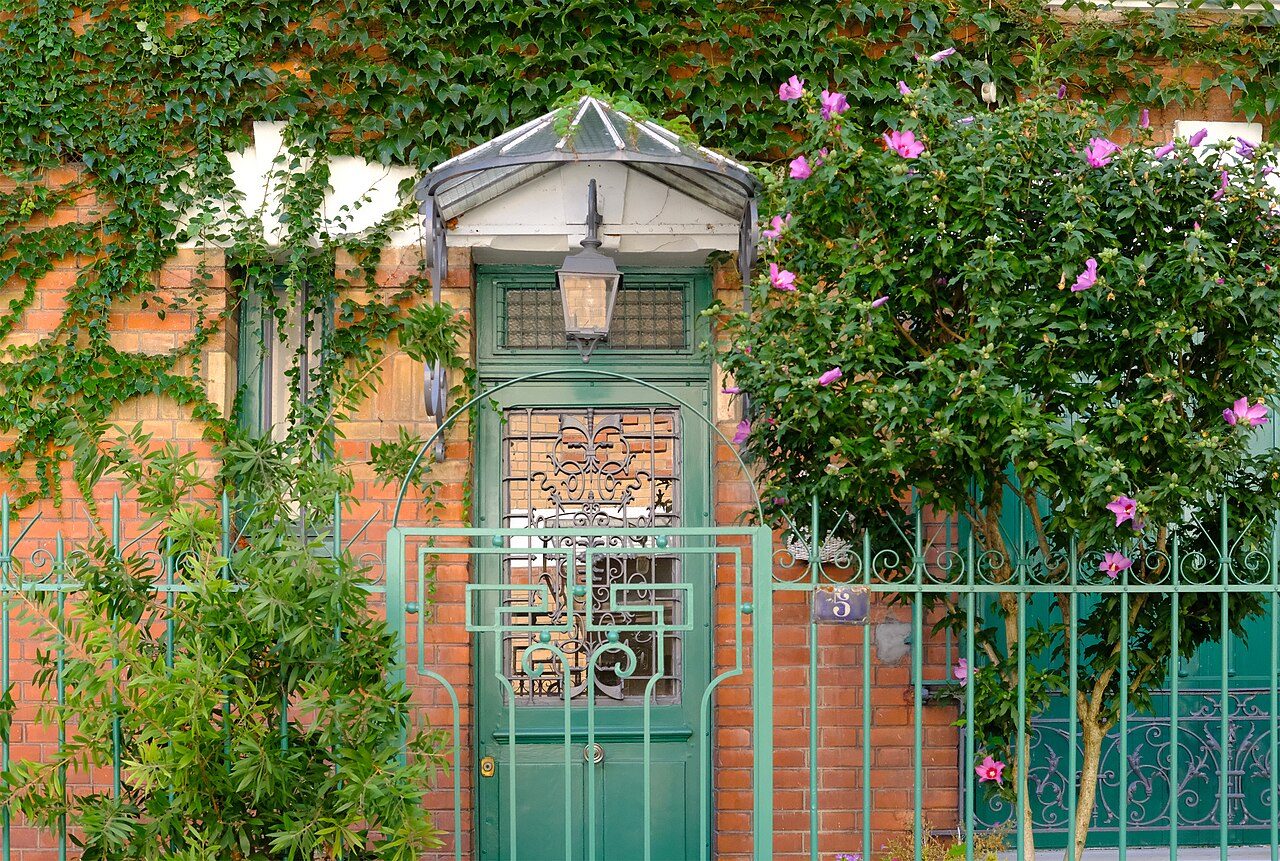
Almost a century later the names have come true. Wisteria hangs over the gates in spring, roses and climbing plants cover the walls, and pastel and ochre façades make each lane a different colour. Around the triangle the city has grown tall, so that from inside you look up at tower blocks over the hedges. It is not a museum or a park but a place where people live, which is precisely its charm: walk quietly.
What to look for
- The street signs: Glycines, Iris, Liserons, Orchidées, Volubilis, Mimosas.
- Wisteria over the gates, at its best in spring.
- The curve of rue Brillat-Savarin, which follows the buried Bièvre.
- The contrast between the small houses and the tall blocks that surround the triangle.
Timeline
- 1443The dyer Jean Gobelin settles on the Bièvre
- 1860Haussmann and Belgrand conclude that the Bièvre must be covered
- 1912Last open stretches in Paris, including the Glacière, covered
- 1928The Cité florale is laid out and built (uncertain date)
Plaques within 250 m
- 59 Rue Brillat-Savarin · 120 m
Fernand Braudel / 1902-1985 / Historien / Professeur au collège de France / membre / de l'Académie Française / a vécu dans cet immeuble / de 1970 à 1985.
Commemorative plaques, Ville de Paris open data (ODbL); transcriptions as published, in French.
Sources
- Wikipédia: Cité florale
- Wikipédia: Rue de la Glacière
- Wikipédia: Bièvre (affluent de la Seine)
- Paris la douce: Cité Florale, la parenthèse enchantée
- Lutèce du Parisien: À la découverte de la Cité Florale
- Paris ZigZag: La Cité florale, micro-quartier pittoresque du 13ème
- Wikidata Q2974809 (coordinates, CC0)