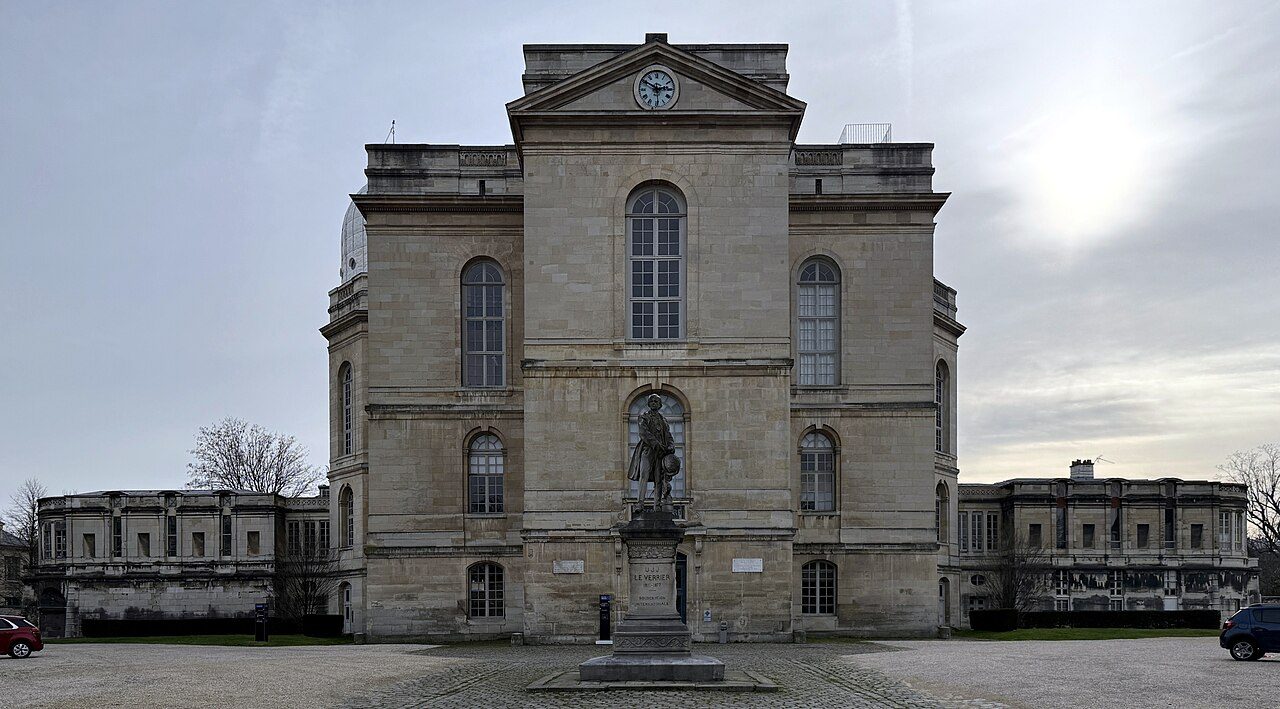
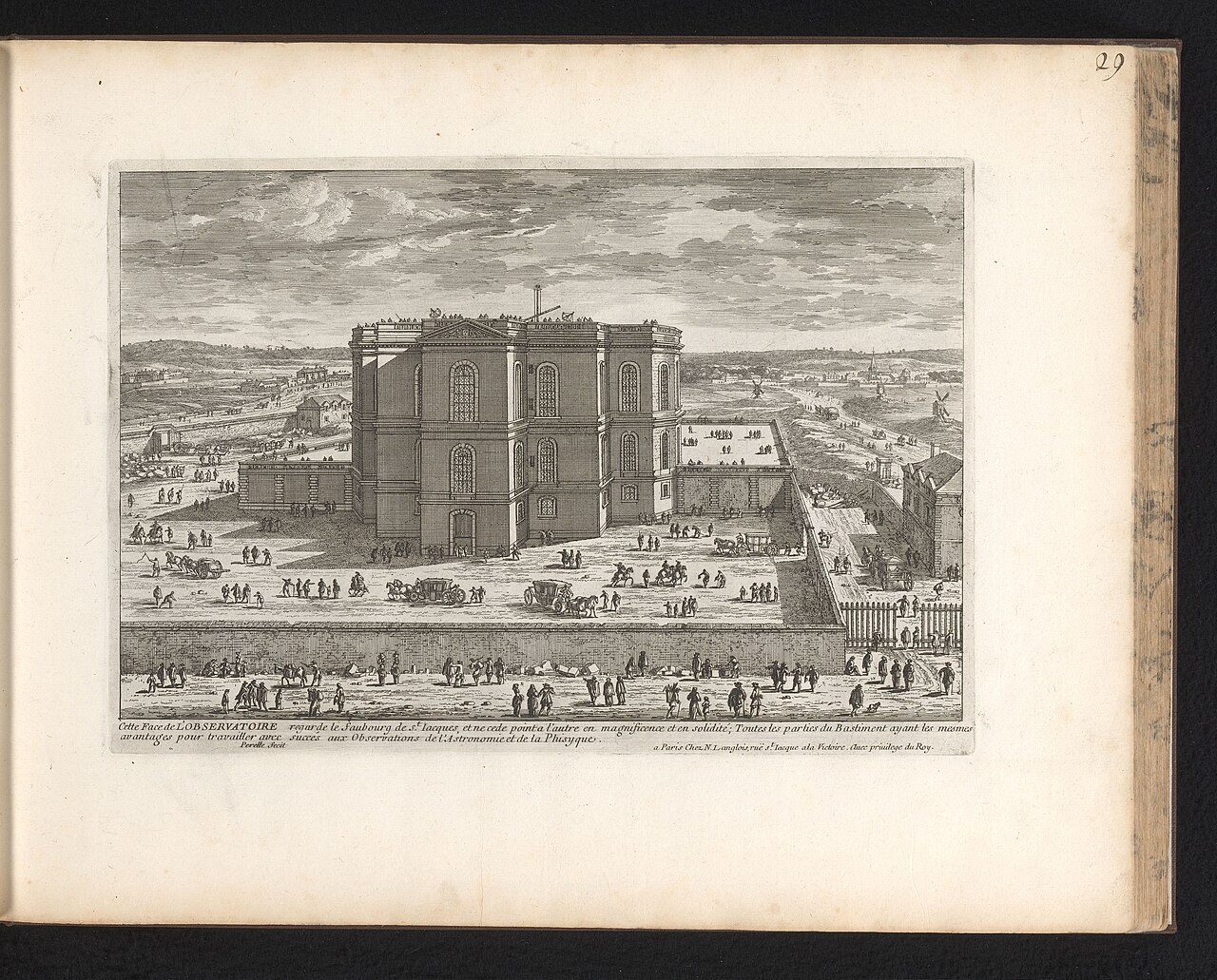
In 1666 Colbert gave Louis XIV a new Academy of Sciences, and the academicians needed somewhere to watch the sky. A site was chosen on open ground south of the city, and on the summer solstice of 1667, 21 June, the mathematicians of the Academy traced on it the line that would become the meridian of Paris. The building was entrusted to Claude Perrault, physician, anatomist and architect, brother of Charles Perrault of the fairy tales, and it was built between 1667 and about 1672, its main axis laid exactly north to south and its walls turned to the cardinal points.
Perrault designed a monument; the astronomers wanted a working instrument. Giovanni Domenico Cassini, called from Bologna in 1669, objected to much of the plan, and the building was altered as it rose. Cassini stayed, became French as Jean-Dominique, and his son, grandson and great-grandson ran the observatory after him for over a century. From these terraces Cassini found four moons of Saturn, and in 1676 the Danish astronomer Ole Rømer, working here with Cassini’s observations of Jupiter’s moons, concluded that light does not travel instantly but at a finite speed.
The meridian runs through the middle of the building, marked by a brass line in the floor of the great hall now named after Cassini. It was the zero of French maps and of Paris time until 1911, and it served for the survey from Dunkirk to Barcelona that defined the metre. In the nineteenth century, under François Arago and then Urbain Le Verrier, domes were added to the roof for new telescopes.
Paris is often described as the oldest astronomical observatory still working on its original site. In 1994 the Dutch artist Jan Dibbets was commissioned to make a memorial to Arago: 135 small bronze medallions set into pavements, courtyards and floors along the line of the meridian across the city, from north to south. They are a modern artwork, not historic markers, and several have been lost to theft and roadworks, but following them is a way to walk the meridian through Paris.
What to look for
- The building itself, oriented exactly to the compass points on the meridian.
- The nineteenth-century domes on the roof, including the Arago dome.
- Jan Dibbets’s bronze ‘ARAGO’ medallions in the pavement nearby, marked N and S.
- The long view north from the observatory along the avenue de l’Observatoire to the Luxembourg, which follows roughly the line of the meridian.
Timeline
- 1667Meridian traced on 21 June; construction begins to Claude Perrault’s design
- 1669Giovanni Domenico Cassini arrives from Bologna
- c. 1672Building completed (uncertain date)
- 1676Rømer concludes that light travels at a finite speed
- 1926Listed as a historic monument
- 1994Jan Dibbets commissioned for the Arago medallions
Plaques within 250 m
- 16 Rue Cassini · 100 m
Camille Flammarion 1842-1925 Fondateur de l'Observatoire de Juvisy et de la Société astronomique de France a vécu dans cette maison
- 34 Rue Du Faubourg-Saint-Jacques · 110 m
ACHILLE OUVRÉ / Peintre-Graveur / NÉ A PARIS LE 26 JUILLET 1872 / A HABITE DEPUIS 1911 / DANS CETTE MAISON / OÙ IL EST MORT LE 26 MARS 1951
- 2 Rue Cassini · 130 m
ICI / ALAIN- FOURNIER / 1886-1914 / A ÉCRIT LE GRAND MEAULNES / AVANT DE DISPARAÎTRE SUR LES HAUTS-DE-MEUSE / LE 22 SEPTEMBRE 1914 / """"Je cherche quelque chose de plus mystérieux encore...""""
- 34 Avenue De L'observatoire · 170 m
ICI FUT ARRETE / JEAN CAVAILLES / PROFESSEUR A LA SORBONNE / HEROS DE LA RESISTANCE / FUSILLE PAR LES ALLEMANDS / AU DEBUT DE 1944
- 92 Avenue Denfert-Rochereau · 200 m
INFIRMERIE MARIE THÉRÈSE / FONDÉE EN 1819 / PAR MME. DE CHATEAUBRIAND QUI REPOSE DANS LA CHAPELLE / CHATEAUBRIAND / HABITA ICI / DE 1826 À 1838
- 85 Boulevard Arago · 220 m
LA STATUE DE FRANCOIS ARAGO ÉRIGÉE EN 1893 A ÉTÉ DÉTRUITE EN 1942 PAR LE GOUVERNEMENT DE VICHY / LA VILLE DE PARIS ET L'ÉTAT ONT SOUHAITÉ RENOUVELER L'HOMMAGE PUBLIC / EN COMMANDANT À JEAN DIBBETS EN 1994 UN MONUMENT IMAGINAIRE CONcU PAR L'ARTISTE / ET COMPOSÉ de MÉDAILLONS MARQUÉS DU NOM DE L'ASTRONOME: ILS ONT ÉTÉ FIXÉS AU SOL SUR LE PAROCURS DU MÉRIDIEN DE PARIS/QUI TRAVERSE LA CAPITALE DU NORD AU SUD ET COUPE CETTE PLACE / A LA HAUTEUR DU SOCLE DE L'ANCIENNE STATUE
- 87 Boulevard Arago · 240 m
EN HOMMAGE AUX HABITANTS DE L'ILE DE / SEIN / EN JUIN 1940 LA MAJORITE DES SENANS / RALLIENT LES FORCES FRANCAISES LIBRES / ""CE JOUR-LA ILS ETAIENT LE QUART DE / LA FRANCE"" / LE GENERAL DE GAULLE / LE 1ER JANVIER 1946 L'ILE DE SEIN / DEVIENT VILLE COMPAGNON DE LA / LIBERATION
Commemorative plaques, Ville de Paris open data (ODbL); transcriptions as published, in French.
Sources
- Wikipédia: Observatoire de Paris
- Wikipedia: Paris Observatory
- Sortiraparis: Peut-on aller dans l’Observatoire de Paris ?
- Paris ZigZag: L’origine des 135 médaillons disséminés sur le sol de Paris
- Encyclopædia Universalis: Dibbets Jan (1941- )
- Wikidata Q125813120 (coordinates, CC0)
- Base Mérimée PA00086642