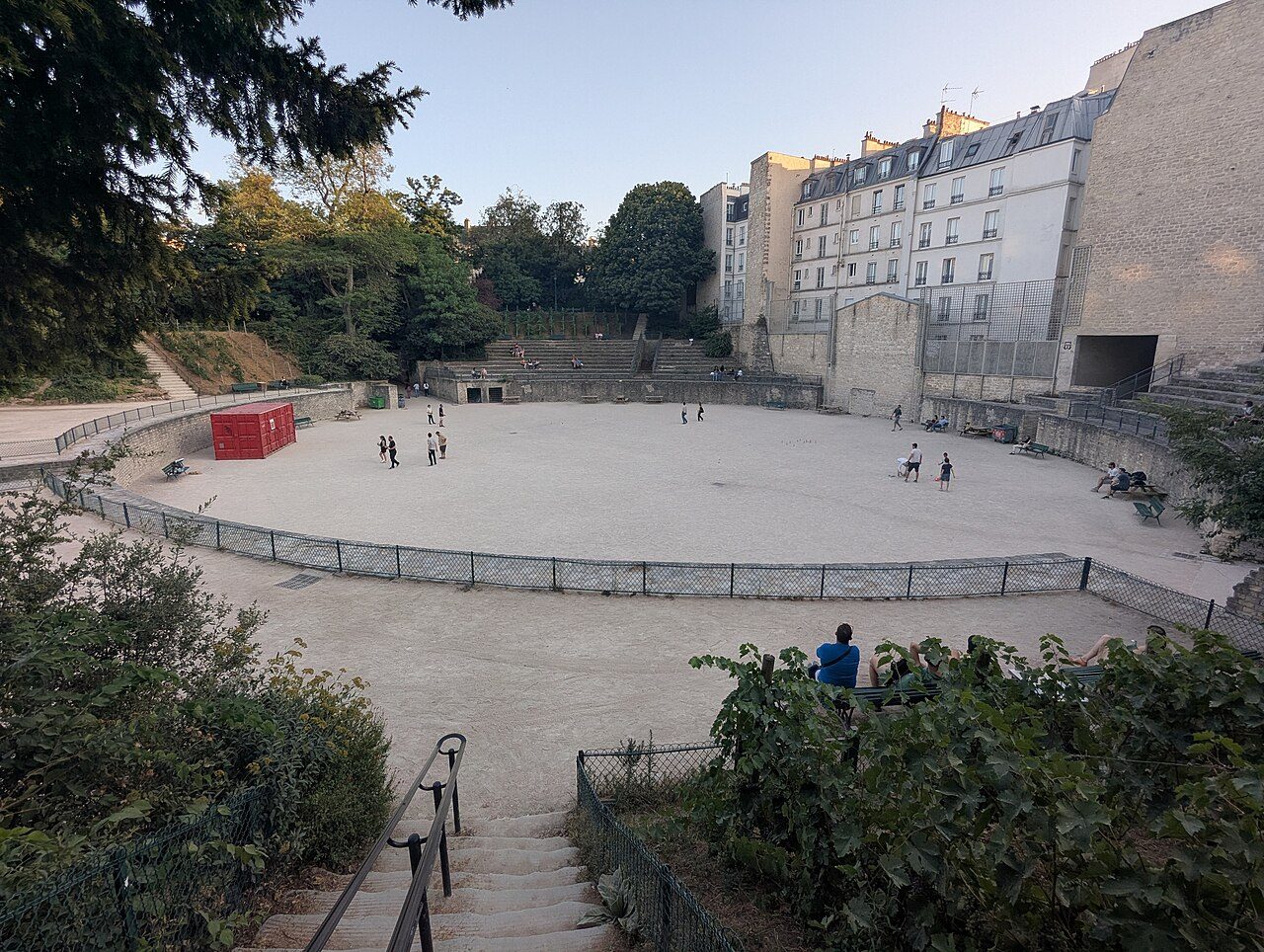
Roman Lutetia built its great place of entertainment on the eastern slope of the hill later called Montagne Sainte-Geneviève, probably in the late first or early second century AD. It was a hybrid building of a kind found in Gaul: half amphitheatre, with an oval arena for animal shows and combats, and half theatre, with a long stage set into one side. Estimates of its capacity run to about fifteen thousand seats, a remarkable figure for a provincial town.
From the third century onwards the town contracted onto the Île de la Cité, and the arena became a quarry. Its stones went into new walls; its bowl filled with earth. By the Middle Ages only a place-name, ‘les Arènes', near the abbey of Saint-Victor, kept a memory of it, and later the spoil from the ditches of Philippe Auguste’s wall buried it further.
It came back by accident. When Haussmann’s engineers cut the rue Monge in the late 1860s, the archaeologist Théodore Vacquer recorded the northern part of the ruins, but the land belonged to the Compagnie générale des omnibus, which wanted a tram depot, and much was destroyed or covered again. A second discovery in 1883, when a convent site to the south was cleared for a new street, set off a public campaign. Victor Hugo, near the end of his life, lent his name to the defenders, and a society of ‘friends of the arenas’ pressed the city to buy and protect what remained. The site was listed as a historic monument in 1884.
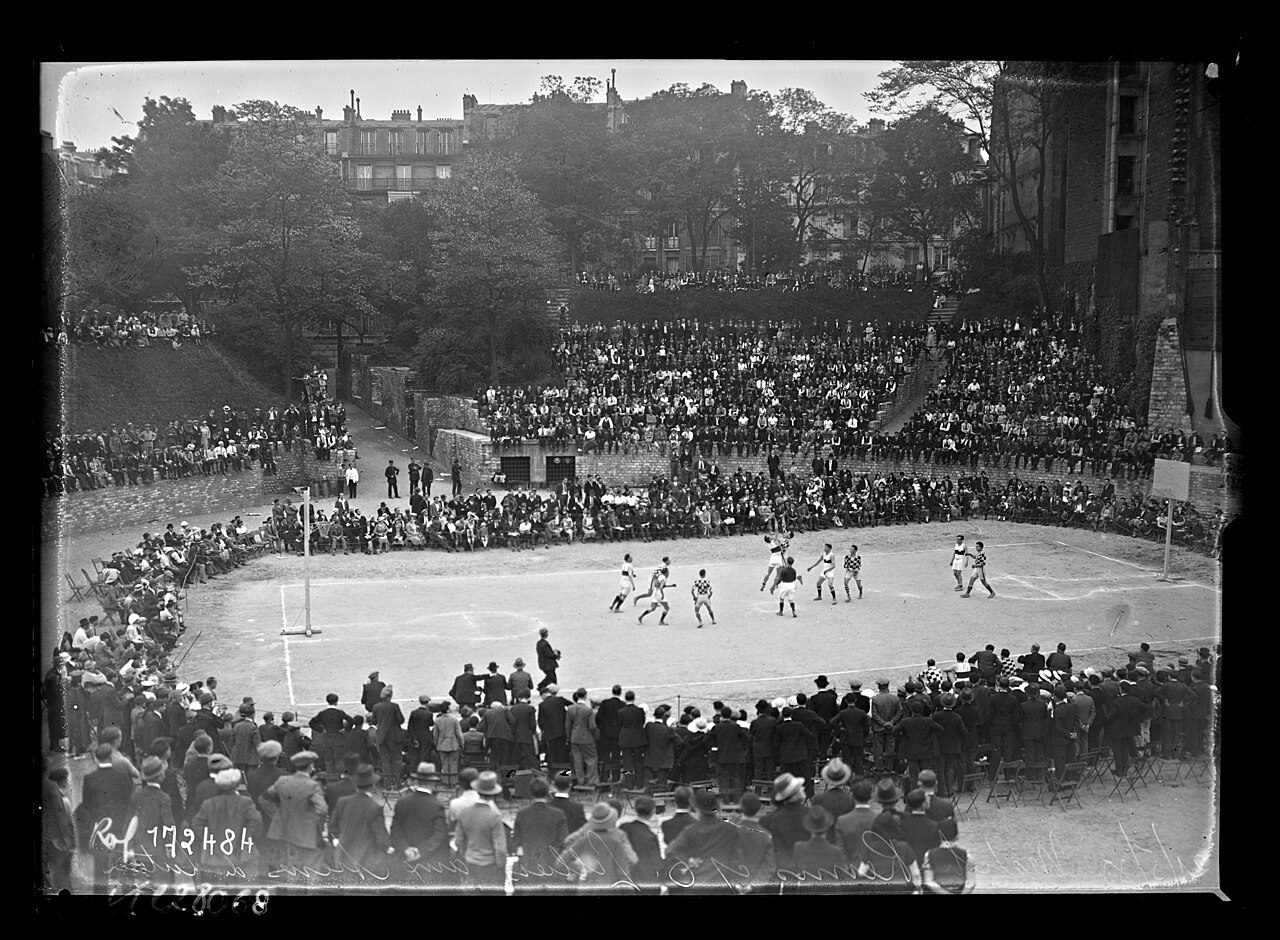
A public garden opened around the southern half in 1892. The rest was recovered only after the city bought out the omnibus company during the First World War; the anthropologist Louis Capitan oversaw excavation and a restoration that rebuilt more than it consolidated, which is why some of the tiers you sit on are early twentieth-century work.
Today the arena is simply a neighbourhood square. Children play football where gladiators may once have fought, older men argue over pétanque, and the stage with its niches faces an audience of pigeons.
What to look for
- The long stage with its nine niches; whether they held statues or served the acoustics is debated.
- The difference between the low, older masonry and the neatly rebuilt upper tiers of the 1910s restoration.
- The entrance at 49 rue Monge, through an ordinary apartment building marked by a gladiator’s bust above the door.
- How the tiers are cut into the slope of the hill, the way Roman builders saved on masonry.
Timeline
- c. 100Arena-theatre built on the slope of the Left Bank hill (uncertain date)
- 1869Northern remains found during the cutting of rue Monge
- 1883Southern part uncovered; campaign to save the site, backed by Victor Hugo
- 1884Listed as a historic monument
- 1892Public square opened around the southern half
- 1915–1918Northern part bought back and restored under Louis Capitan
Plaques within 250 m
- 49 Rue Monge · 50 m
ARENES DE LUTECE / PARTIE NORD DECOUVERTE EN 1869 / PARTIE SUD MISE AU JOUR 1883-1885 / L'ENSEMBLE RESTAURE 1917-1918
- 5 Rue Des Arenes · 60 m
JEAN PAULHAN / 1884 - 1968 / VECUT DANS CETTE MAISON / DE 1940 A SA MORT
- 11 Rue De Navarre · 90 m
EMILE MALE / DE L'ACADEMIE FRANÇAISE / HISTORIEN / DE L'ART CHRETIEN / A VECU / DANS CETTE MAISON / DE 1900 A 1954
- 6 Rue Rollin · 110 m
BENJAMIN FONDANE / (JASSY, 1898-AUSCHWIZ, 1944) / POETE ET PHILOSOPHE FRANÇAIS, HABITA DANS CETTE MAISON / DU 15 AVRIL 1932 AU 7 MARS 1944. / " SOUVENEZ-VOUS SEULEMENT QUE J'ETAIS INNOCENT / ET, TOUT COMME VOUS, MORTELS DE CE JOUR-LA. / J'AVAIS, MOI AUSSI, UN VISAGE MARQUE/ PAR LA COLERE, PAR LA PITIE ET LA JOIE./UN VISAGE D’HOMME TOUT SIMPLEMENT ! "
- 15 Rue Linne · 120 m
STANISLAS FUMET / 1896 - 1983 / HOMME DE LETTRES, RESISTANT / A VECU DANS CET IMMEUBLE / AVEC SON EPOUSE ANIOUTA / DE 1920 A 1983
- 8 Rue Rollin · 130 m
DE 1942 A 1964 AU 8 RUE ROLLIN / L'INSTITUT D'ARSONVAL / CENTRE D'APPRENTISSAGE DE / FORMATION SUPERIEURE DE L'ACADEMIE DE PARIS / A FORME 2600 ASSISTANTS ET ASSISTANTES TECHNIQUES EN / ANALYSES BIOLOGIQUES / ELECTRORADIOLOGIE MEDICALE / ELECTRICITE INDUSTRIELLE │ CREE EN 1942 PAR EDOUARD SOULEBEAU │ INGÉNIEUR DE L'ÉCOLE BREGUET ET DE │ L'ÉCOLE SUPERIEURE D'AERONAUTIQUE │ L'INSTITUT D'ARSONVAL A ETE ANNEXE EN 1961 A │ L'ÉCOLE NATIONALE DE CHIMIE PHYSIQUE BIOLOGIE DE PARIS │ PLAQUE APPOSEE LE 19 AVRIL 2013 PAR │ L'ASSOCIATION DES ANCIENS ÉLEVES │ A L'OCCASION DU 70E ANNIVERSAIRE │ DE LA FONDATION DE L'INSTITUT │ EN PRESENCE DE │ MONSIEUR JEAN TIBERI, MAIRE DU 5E ARRONDISSEMENT │ MONSIEUR DENIS LAMBERT, DIRECTEUR DU CROUS │ MONSIEUR ANDRE SILHONNET, FONDATEUR DE L'ASSOCIATION │ MONSIEUR BERNARD LERAT, PRESIDENT DE L'ASSOCIATION
- 13 Rue Linne · 130 m
L'ECRIVAIN / GEORGES PEREC / A VECU / DANS CET IMMEUBLE / DE 1974 A 1982
- 8 Rue Rollin · 140 m
LA RESIDENCE UNIVERSITAIRE ROLLIN / A ETE INAUGUREE LE / MARDI 21 NOVEMBRE 2006 / PAR / JEAN TIBERI / Député de Paris / Maire du 5ème arrondissement / BERTRAND LANDRIEU / Préfet de la région Ile-de-France / Préfet de Paris / BERTRAND DELANOË / Maire de Paris / ??? / ???? / JEAN-PAUL HUCHON / Président du Conseil régional d'Ile-de-Frace
Commemorative plaques, Ville de Paris open data (ODbL); transcriptions as published, in French. 17 in all within this radius.