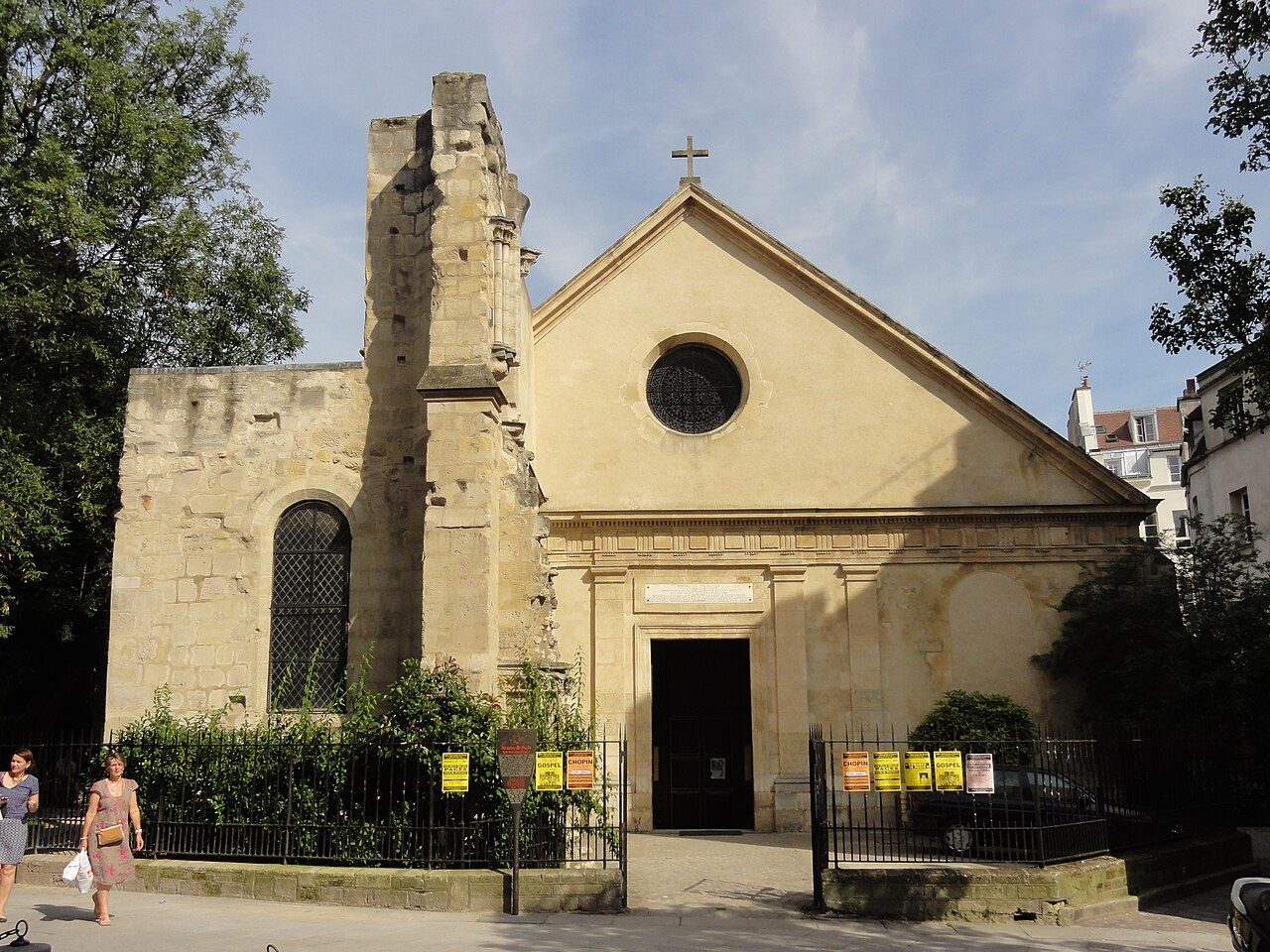
There was a sanctuary here by the sixth century, beside a hospice for travellers on the road that crossed the Seine to the Île de la Cité. It was sacked by the Vikings in 886, given back to the bishop’s chapter in the eleventh century, and around 1125 handed to the Cluniac monks of Longpont, who began to rebuild. The church you see was started around 1160–1170, in the same years as Notre-Dame across the river, and shares its moment between Romanesque and Gothic. It was never finished as planned. Which Julian it honours is itself uncertain: the hospitaller saint of the legend, or one of two early bishops and martyrs of that name.
For three centuries this was the University’s church. The masters and students of the Latin Quarter held assemblies here, and the election of the rector took place under its vault, until a riot in 1524 wrecked the interior and the meetings moved elsewhere. In 1651 the church, by then decrepit, was shortened by two bays and given the plain classical front it still has; soon afterwards the priory was united with the Hôtel-Dieu, the great hospital opposite.
The Revolution turned it into a salt store. Restored to worship in 1826 and listed as a historic monument in 1846, it was given in 1889 to the Melkite Greek Catholic community, Arabic-speaking Christians of the Byzantine rite from Syria and Lebanon. Their carved wooden iconostasis, made in Damascus, was inaugurated in 1891 and now closes off the medieval choir. In April 1921 the Dadaists chose the churchyard for their first ‘excursion’ to a deliberately meaningless place; hardly anyone came.
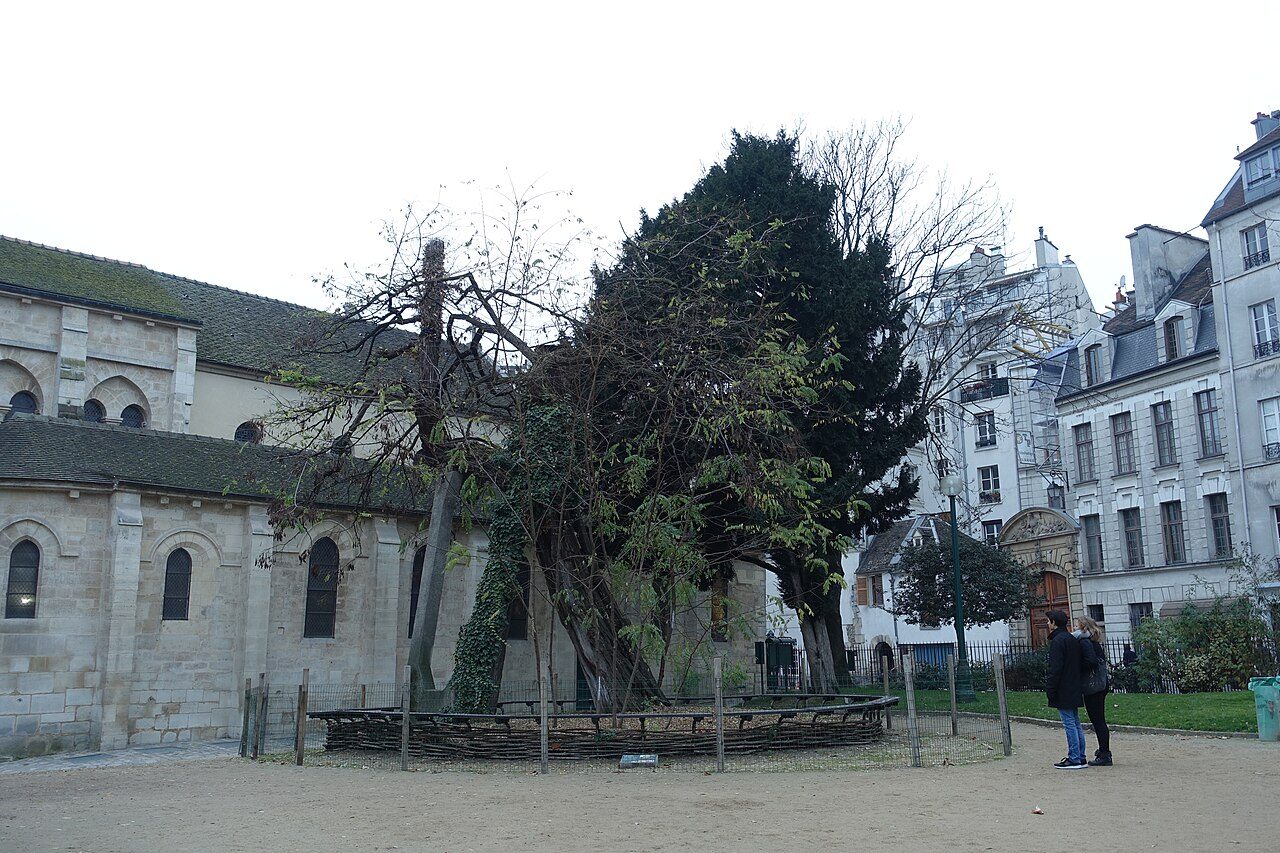
Beside the church, square René-Viviani was laid out on the site of demolished priory buildings in the late 1920s. Its oldest inhabitant leans on a concrete crutch: a black locust, or robinia, which the City of Paris says was planted in 1601 by Jean Robin, gardener and herbalist to Henri IV, whose name the genus now bears. That makes it, by tradition, the oldest tree in Paris. The view across the river to Notre-Dame is one of the best on the Left Bank.
What to look for
- The robinia propped on its concrete supports near the church wall.
- The wooden iconostasis from Damascus, closing the twelfth-century choir.
- The well curb preserved inside the church.
- The outside of the apse from the square, the oldest part of the building.
- Georges Jeanclos’s bronze fountain of 1991 in the square.
Timeline
- c. 1160–1170Present church begun by the monks of Longpont (uncertain date)
- 1524A riot during a University election damages the church
- 1601Robinia traditionally planted by Jean Robin (uncertain date)
- 1651Nave shortened and new façade built
- 1846Listed as a historic monument
- 1889Given to the Melkite Greek Catholic community
- 1921The Dada ‘excursion’ of 14 April
Plaques within 250 m
- 1 Bis Rue Saint Julien Le Pauvre · 0 m
REPUBLIQUE FRANÇAISE / LIBERTE - EGALITE - FRATERNITE / ADMINISTRATION GENERALE DE L'ASSISTANCE PUBLIQUE A PARIS / EGLISE SAINT-JULIEN-LE-PAUVRE / RECONSTRUITE AU XIIE SIECLE PAR LES SOINS DE L'ABBAYE DE LONGPONT ET ERIGEE EN PRIEURE. / L'EGLISE ET LE PRIEURE FURENT CEDES A L'HOTEL-DIEU ET INCORPORE A SON DOMAINE (AVRIL 1655) / P. MELIAND ETANT PRIEUR COMMANDATAIRE DE SAINT-JULIEN, LE CARDINAL MAZARIN ADMINISTRATEUR DE L'ABBAYE DE LONGPONT. /CESSION CONFIRMEE PAR BULLE DU PAPE ALEXANDRE VII (8 MARS 1659) ET LETTRES PATENTES DU ROI LOUIS XIV (JUIN 1697) /RESTITUEE A L'HOTEL-DIEU APRES LE REVOLUTION PAR DECRET IMPERIAL DE 1805. CETTE EGLISE A ETE AFFECTEE EN 1892 AU CULTE CATHOLIQUE GREC.
- 13 Rue De La Bucherie · 100 m
L'ANATOMISTE /JACQUES BENIGNE WINSLOW / 1669 - 1760 / NE A ODENSE - DANEMARK / INAUGURA ICI SON AMPHITHEATRE / 1745 / ASSOCIATION MEDICALE FRANCO-DANOISE / FONDATION NOVO / 1959
- 16 Rue De La Bûcherie · 120 m
DANS CETTE MAISON MOURUT/LE 3 FÉVRIER 1806/NICOLAS-EDME RESTIF DE LA BRETONNE/AUTEUR DU '’PAYSAN PERVERTI""""/ET DES '’NUITS DE PARIS'’
- 11, Rue De La Bucherie · 120 m
DANS CET IMMEUBLE / SIMONE DE BEAUVOIR/1908-1986 / A ECRIT ""LE DEUXIÈME SEXE"" (1949) / OUVRAGE FONDATEUR / DU FEMINISME MODERNE / ET / ""LES MANDARINS"" (1954) / PRIX GONCOURT
- 61 Quai Du Marche-Neuf · 180 m
ICI FUT REÇU / LE 24 AOÛT 1944 / D'UN AVION LÉGER / DE LA 2e DIVISION BLINDÉE / LE MESSAGE DU GÉNÉRAL LECLERC / AUX PARISIENS COMBATTANTS / """"TENEZ BON NOUS ARRIVONS""""/ LANCÉ / PAR LE CAPITAINE JEAN CALLET / ET PAR / LE LIEUTENANT ÉTIENNE MANTOUX /MORT AU CHAMP D'HONNEUR
- 88 Boulevard Saint Germain · 190 m
Gabriel BALBO / 1943 - 2021 / Psychanalyste / Fondateur de la / Libre Association Freudienne / a vécu et exercé / dans cet immeuble de 1981 à 2021
- 3 Rue De Boutebrie · 200 m
ICI FUT INAUGURÉE LE 12 NOVEMBRE 1924 « L’HEURE JOYEUSE », PREMIÈRE BIBLIOTHÈQUE POUR LA JEUNESSE EN FRANCE. OFFERTE AUX ENFANTS DE PARIS PAR LE COMITÉ AMERICAIN « THE BOOK COMMETTEE ON CHILDREN’S LIBRAIRIES », ELLE DEMEURERA EN CE LIEU JUSQU’EN 1974. CLAIRE HUCHET, MARGUERITE GRUNY ET MATHILDE LERICHE EN FURENT LES PREMIÈRES BIBLIOTHÉCAIRES. POUR FAVORISER LA LECTURE ET PROMOUVOIR L’UTOPIE D’UN MONDE EN PAIX, ELLES S’APPUYÈRENT SUR LE PRINCIPE DE L’ « EDUCATION NOUVELLE » VISANT À DONNER UNE LARGE AUTONOMIE AUX ENFANTS. ELLES INSPIRÈRENT DES GÉNÉRATIONS D’AUTEURS JEUNESSE
- 90 Boulevard Saint-Germain · 200 m
CHARLES GARNIER / ARCHITECTE DE L'OPERA / NE A PARIS LE 6 NOVEMBRE 1825 / EST MORT DANS CETTE MAISON / LE 3 AOUT 1898
Commemorative plaques, Ville de Paris open data (ODbL); transcriptions as published, in French. 14 in all within this radius.
Sources
- Ville de Paris: Square René Viviani
- Wikipédia: Église Saint-Julien-le-Pauvre de Paris
- Wikipedia: Saint-Julien-le-Pauvre
- Monumentum (Mérimée PA00088416): Église Saint-Julien-le-Pauvre
- Wikipedia: Locust of Square René-Viviani
- Paris ZigZag: L’église Saint-Julien-le-Pauvre, une oubliée de la Rive gauche
- Wikidata Q1243760 (coordinates, CC0)
- Base Mérimée PA00088416