In 1859 a new railway left a terminus at the place de la Bastille and ran east towards Vincennes and the Marne villages beyond. To clear the streets of the faubourg, it rode out of the city on a long brick and stone viaduct along what became the avenue Daumesnil, then dropped into cuttings and tunnels. For a century it carried suburban passengers in and out of the city. In 1969 the line closed; its eastern part was absorbed into the new RER, and the Bastille station was eventually demolished to make room for the Opéra Bastille.
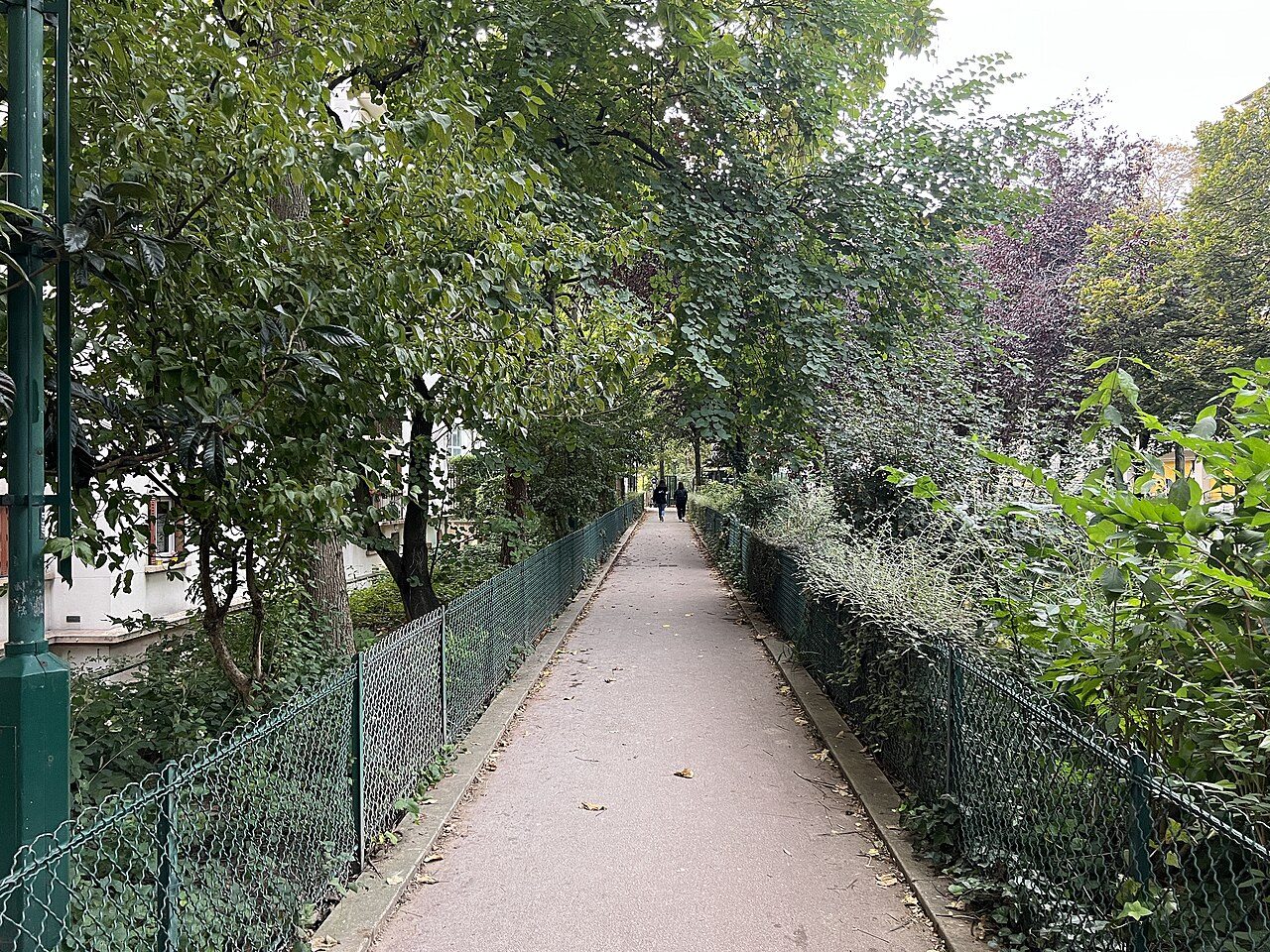
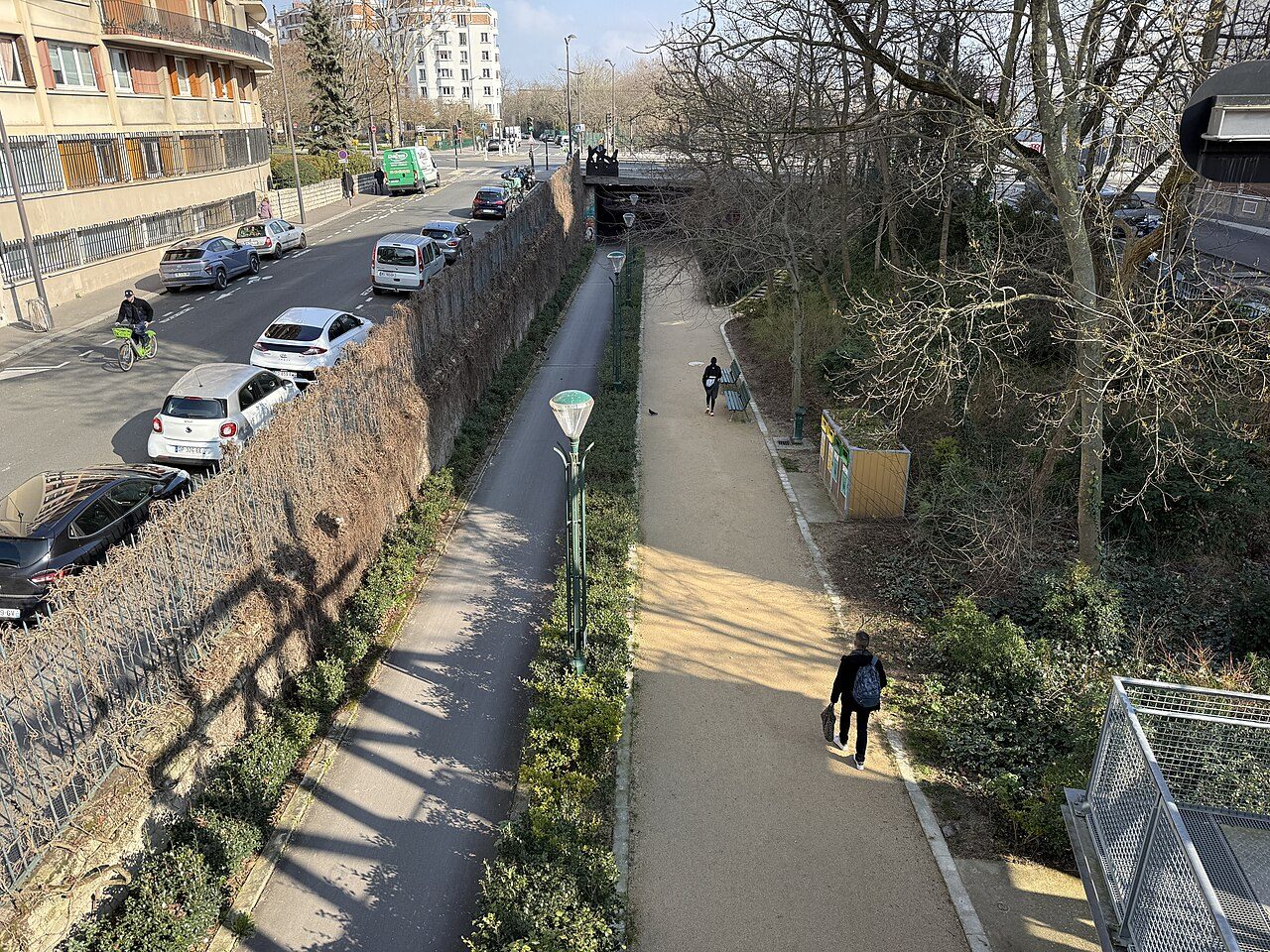
That left a ribbon of railway land a few kilometres long, half of it in the air. From 1988 the landscape architect Jacques Vergely and the architect Philippe Mathieux turned it into a continuous garden walk, opened in 1993: a planted path on top of the viaduct, then footbridges, tunnels, cuttings and a string of gardens at ground level, running some four and a half kilometres to the edge of the city. It is described as the first garden ever laid out on a railway viaduct, and New York’s High Line, opened in 2009, drew on its example.
Beneath it, the viaduct’s arches were restored from 1989 onwards by the architect Patrick Berger, who closed each one with a tall glazed front. The Viaduc des Arts, as it is now called, gives its vaults to some forty craftsmen and makers in fashion, decoration, jewellery and the applied arts, many of them working in view of the street.
The walk was renamed in 2013 after René Dumont, the agronomist who in 1974 became the first ecologist to stand for the French presidency. Its planting deliberately mixes the cultivated and the wild: designed beds along the viaduct, poppies and bindweed that came with the railway, and in the tunnels bats, mostly common pipistrelles, which shelter there in winter. From the top, the 12e is seen at first-floor level: window boxes, kitchen windows, and on the police station at no. 80 avenue Daumesnil, a row of giant figures copied from Michelangelo.
What to look for
- The glazed arches of the Viaduc des Arts along avenue Daumesnil, with workshops behind the glass.
- The tunnels and cuttings further east, where the walk drops below street level.
- Wild poppies and bindweed, descendants of the railway’s own flora.
- Opposite the viaduct, the police station at 80 avenue Daumesnil, its upper floors lined with copies of Michelangelo’s Dying Slave, placed there by the architect Manuel Núñez Yanowsky around 1991.
Timeline
- 1859Vincennes railway opens from the Bastille
- 1969Line closed
- 1988Work on the promenade begins (Vergely and Mathieux)
- 1989Rehabilitation of the viaduct arches begins (Patrick Berger)
- 1993Promenade plantée opened
- 2013Renamed Coulée verte René-Dumont
Plaques within 250 m
- 45 Rue De Lyon · 50 m
DEVANT CET IMMEUBLE / MARCEL HAUVILLE, 21 ANS /EXTERNE DES HÔPITAUX / MEDECIN DU POSTE F.F.I. DU IVe ARRT / MATHIEU KERVELLA, 26 ANS / CONTRÔLEUR DES DOUANES / SECOURISTE DU POSTE F.F.I. DU IVe ARRT / SONT MORTS POUR LA France / 20 Août 1944
- 3 Rue Mathurin Moreau · 120 m
Alors que l’Exposition coloniale internationale et des pays d’Outre-Mer ouvre ses portes en 1931 dans le bois de Vincennes, un Manifeste des intellectuels surréalistes, proches de la gauche communiste et anticolonialiste, intitulé « Ne visitez pas l’Exposition coloniale », dénonce les fastes coloniaux de Vincennes. Le 19 septembre 1931, avenue Mathurin Moreau, dans l’ancien pavillon des Soviets de l’exposition des Arts décoratifs de 1925, sera inaugurée une contre-exposition coloniale intitulée « La vérité sur les colonies », à l’initiative des Surréalistes, de militants de la CGTU et d’opposants au colonialisme. Le 2 décembre 1931, elle fermera ses portes.
Commemorative plaques, Ville de Paris open data (ODbL); transcriptions as published, in French.