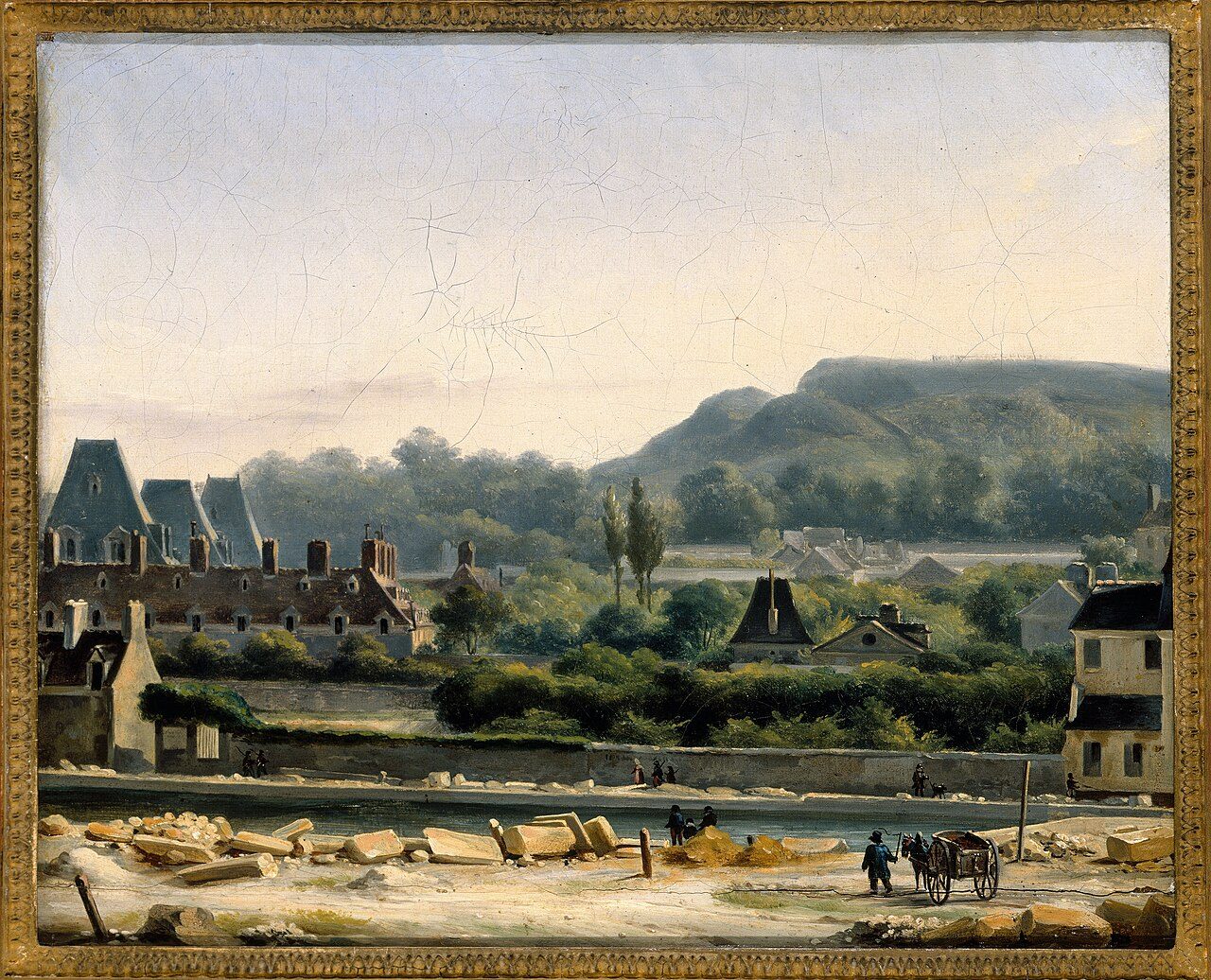
Plague came back to Paris again and again in the late sixteenth century, and each time the Hôtel-Dieu beside Notre-Dame was overwhelmed, with the sick crowded several to a bed in the middle of the city. After the epidemics of 1605–1606, Henri IV decided by an edict of May 1607 to build a house of health well outside the walls, beyond the porte du Temple on the road towards Belleville, far enough to protect the city and near enough for doctors to reach it. The king laid the first stone of the chapel that summer, and the hospital was dedicated to Saint Louis, his royal ancestor, who had died of disease on crusade outside Tunis in 1270.
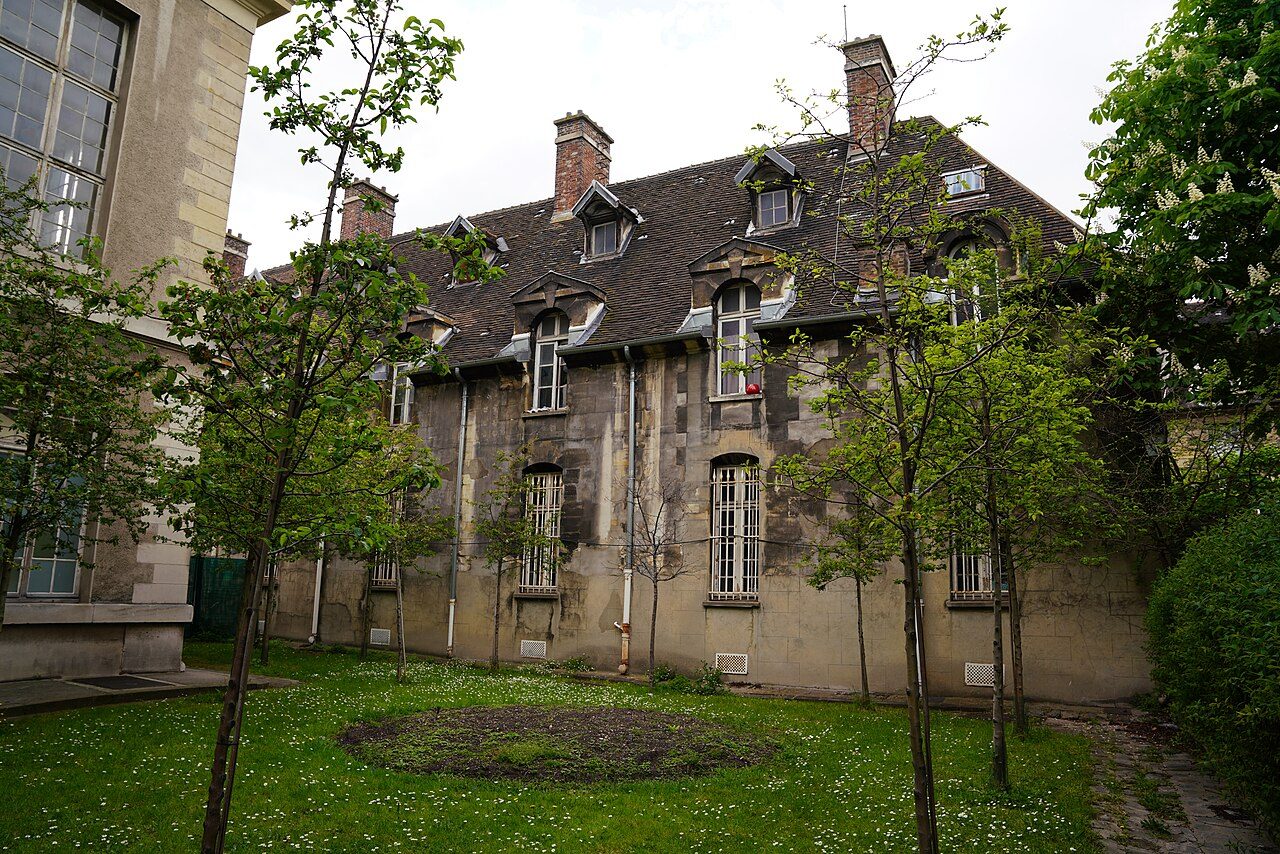
The design, attributed to Claude Vellefaux (some historians credit Claude Chastillon), is a great square of wards around an open courtyard, built in the same brick and pale stone as the place Royale, now the place des Vosges, which went up in the same years under the same king. The comparison is often made, and it is apt: both are expressions of Henri IV’s Paris, orderly, airy and red and white. But the hospital was built for isolation, almost like a fortress: each side of the square, some 120 metres long, held a single long ward on each floor, the staff lived in separate buildings set at the corners, and a double wall kept the contagion in.
It was finished around 1612 and for a long time opened only during epidemics. After the fire at the Hôtel-Dieu in 1772–1773 it took in patients permanently, and in the nineteenth century it became the cradle of French dermatology. Jean-Louis Alibert founded a school of skin medicine here, and from 1863 the craftsman Jules Baretta, who had made papier-mâché fruit, modelled diseased skin in painted wax for teaching. His casts became the core of the musée des Moulages, one of the strangest medical collections in Europe.
The modern hospital, built from the 1970s and partly sunk below ground level so as not to dwarf the old buildings, now surrounds the seventeenth-century core. The historic quadrangle, listed in stages from 1937, houses offices and services; its courtyard garden, planted with trees and lawns, is one of the calmest places in the 10th arrondissement. Remember that this is a hospital: people come here because they are ill, or with someone who is.
What to look for
- The brick and stone façades and steep slate roofs, close cousins of the place des Vosges.
- The square courtyard at the heart of the old quadrangle, and the sheer length of the wards around it.
- The chapel, whose first stone the king laid in 1607.
- The way the modern hospital steps down around the old buildings rather than towering over them.
Timeline
- 1607Edict of Henri IV founding the hospital; first stone of the chapel
- c. 1612Buildings completed; used only during epidemics (uncertain date)
- 1773After the Hôtel-Dieu fire, the hospital takes patients permanently (uncertain date)
- 1889Musée des Moulages inaugurated
- 1937First heritage protection of the historic buildings
- 1984–1989Modern hospital completed around the old core
Plaques within 250 m
- 33 Rue De La Grange-Aux-Belles · 100 m
A LA MEMOIRE / DES 3710 HOMMES ARRETES / LORS DE LA RAFLE DU "BILLET VERT" / LE 14 MAI 1941 / PAR LA POLICE FRANCAISE / SUR ORDRE DE L'OCCUPANT NAZI / NOMBRE D'ENTRE EUX CONVOQUES AU 33 / RUE DE LA GRANGE-AUX-BELLES FURENT / RASSEMBLES DANS DES LOCAUX AU FOND DE / CETTE IMPASSE, PUIS INTERNES DANS LES / CAMPS DU LOIRET / AVANT D'ETRE DEPORTES A AUSCHWITZ / POUR LE SEUL FAIT D'ETRE NES JUIFS
- 16 Rue Vicq D'azir · 220 m
1892 - 1992| LE 17 OCTOBRE 1992| CLAUDE CHALLAL| ADJOINT AU MAIRE DE PARIS| MAIRE DU 10EME ARRONDISSEMENT| ET | CLAUDE GÉRARD MARCUS| CONSEILLER DE PARIS| VICE PRÉSIDENT DU CONSEIL GÉNÉRAL| DÉPUTÉ DU 10EME ARRONDISSEMENT| ONT PRÉSIDÉ LES CÉRÉMONIES| POUR LA CÉLÉBRATION DU CENTENAIRE| DE L'ÉCOLE VICQ D'AZUR
Commemorative plaques, Ville de Paris open data (ODbL); transcriptions as published, in French.
Sources
- Ville de Paris: Grandes et petites histoires sur les hôpitaux parisiens
- Wikipédia: Hôpital Saint-Louis
- Wikipedia: Hôpital Saint-Louis
- Le Quotidien du médecin: L’hôpital Saint-Louis et son musée des moulages
- Paris ZigZag: Petite histoire de l’hôpital Saint-Louis
- Wikidata Q1569396 (coordinates, CC0)
- Base Mérimée PA00086494