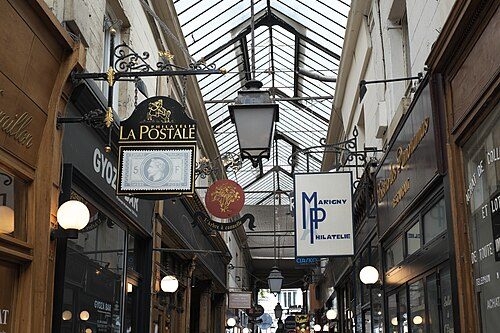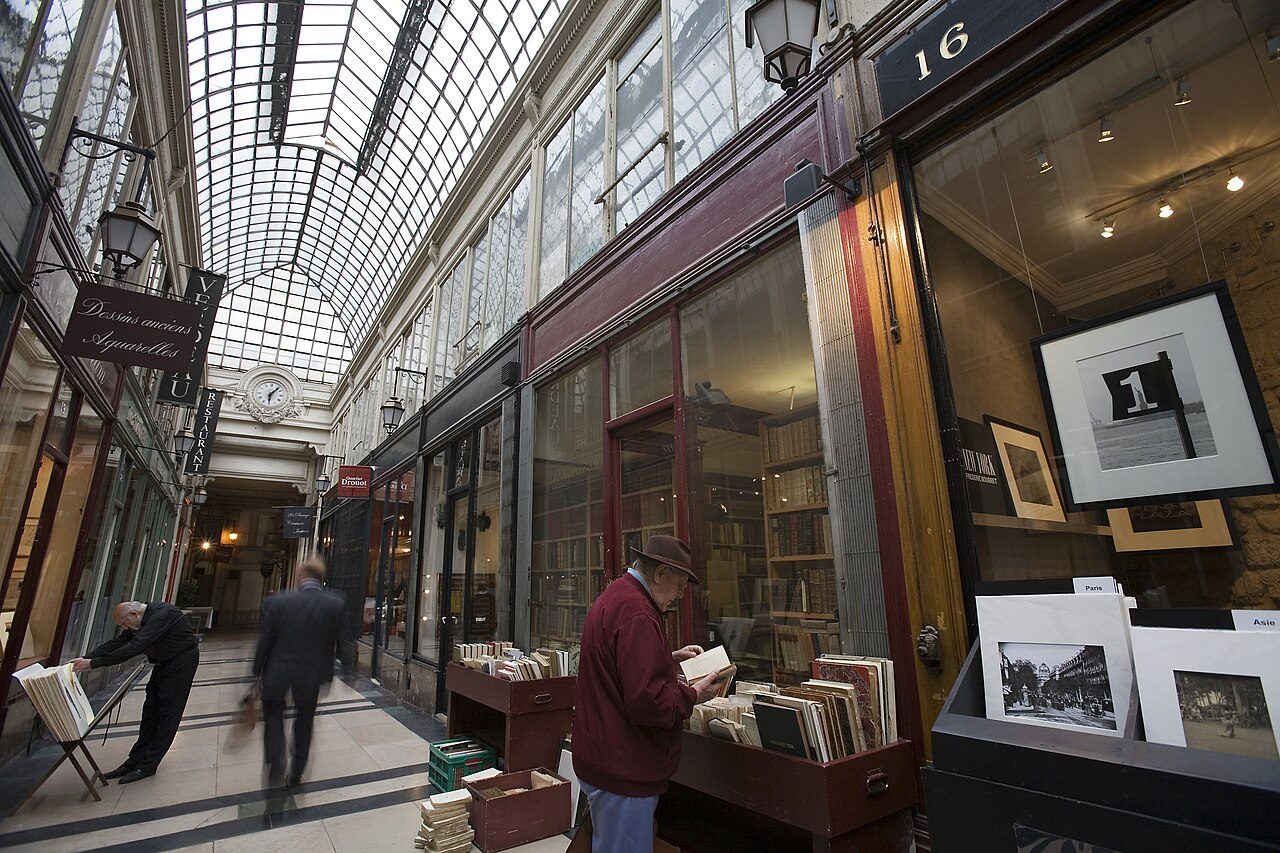
By the 1840s the Passage des Panoramas was so busy that a company of investors bet its crowds would cross the boulevard Montmartre if a second passage waited on the other side. The company was chaired by Félix de Jouffroy-Gonsans, who gave the new passage his name, and the architects were François-Hippolyte Destailleur and Romain de Bourges. Works began in 1845 and the passage opened in the following two years; sources differ on the exact date.
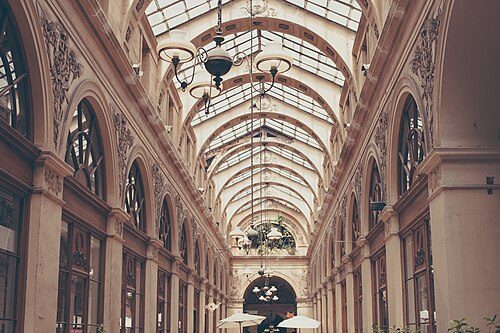
What set it apart was the structure. Earlier passages hid timber behind their plaster; this one was built of iron and glass, with wood kept for ornament, and it was the first in Paris to be warmed through the floor. The site was awkward, an irregular block once part of the gardens of the Hôtel Crozat, so the passage runs straight north, turns at a right angle, drops down a short flight of steps, and turns again before reaching the rue de la Grange-Batelière. The kink is half its pleasure.
Across that street the same idea continues: the Passage Verdeau, named after another member of the company, carries the walker on towards the Faubourg Montmartre. With the Panoramas to the south, the three passages form an almost unbroken covered route of several hundred metres, cut only by the boulevard and one side street.
In 1882 Arthur Meyer, editor of the newspaper Le Gaulois, and the caricaturist Alfred Grévin opened a museum of wax figures beside the passage, its exit giving onto the gallery. The Musée Grévin kept the passage busy when others declined. It was listed as a historic monument in 1974 and restored in 1987, when its original floor was brought back, and again in 2019. A hotel inside the passage, said to date from its opening, has been called the Hôtel Chopin only since the 20th century; no documented link to the composer exists.
What to look for
- The right-angle turn and the short flight of steps halfway along.
- The Musée Grévin’s decorated exit inside the passage.
- The slender iron ribs of the roof, a step beyond the timber of earlier passages.
- The view north across the rue de la Grange-Batelière into the Passage Verdeau, and south across the boulevard to the Panoramas.
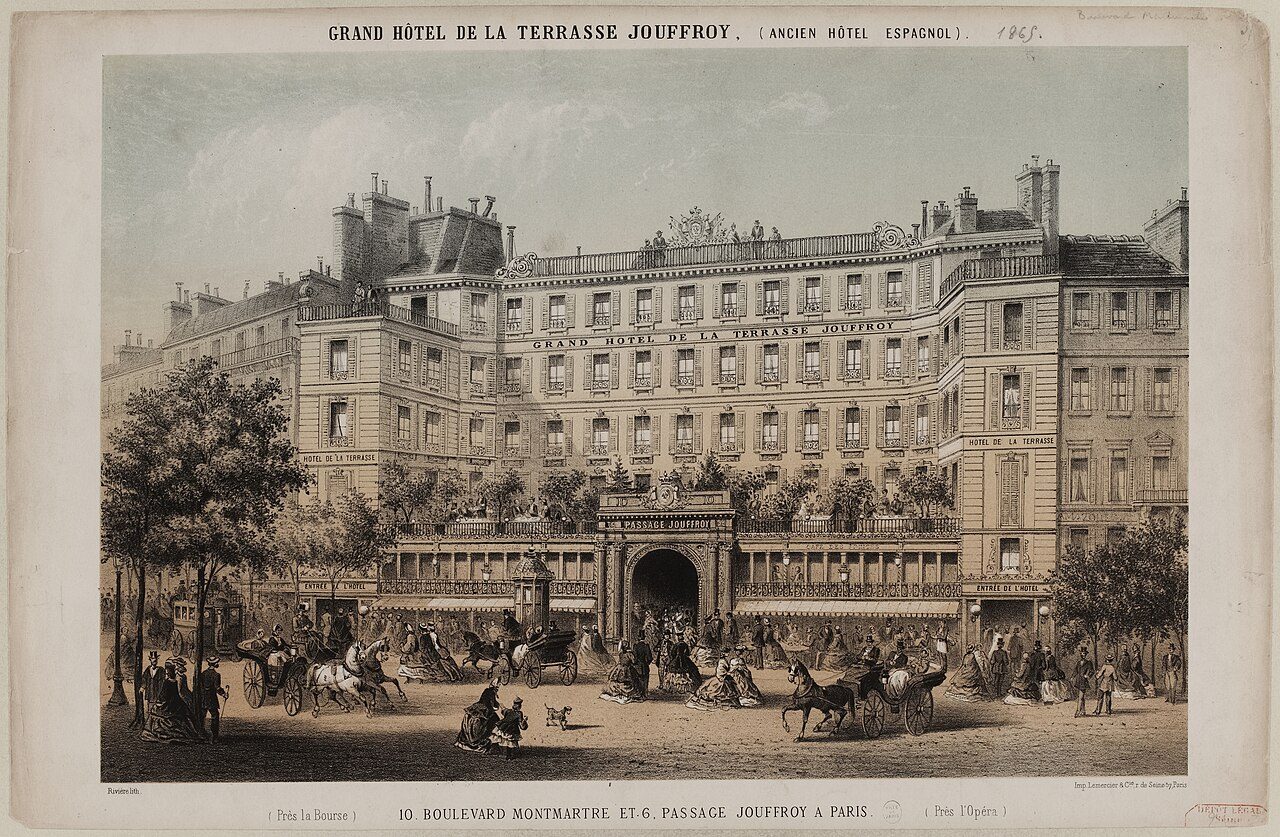
Timeline
- 1845Works begin for the company chaired by Félix de Jouffroy-Gonsans
- 1846Works completed; the City of Paris dates the opening to 1847 (uncertain date)
- 1882The Musée Grévin opens beside the passage
- 1974Listed as a historic monument
- 1987Restoration; original floor reinstated
Plaques within 250 m
- 11 Rue De La Grange Bateliere · 50 m
Comte Félix de Jouffroy Gonsans / Promoteur du passage / 1844
- 10 Rue De La Grange Bateliere · 80 m
EDIFIE SOUS LOUIS XV / HOTEL DE Mr. DE NOLIVOS CAPITAINE / AUX GARDES FRANCAISES SOUS LOUIS XVI / RESIDENCE DU MARQUIS DE LILLERS / CHAMBELLAN DE L'EMPEREUR NAPOLÉON Ier / CERCLE ROMANTIQUE DE Mr. TATTET / QUI RÉUNISSAIT VIGNY.MUSSET / ET VICTOR HUGO
- 4 Rue Rossini · 100 m
ICI / DÉCÉDAIT LE 7 MAI 1951 / LE POÈTE / ROBERT DE BÉDARIEUX
- 1 Rue Drouot · 150 m
ICI SE TROUVAIT/LE GOLF DROUOT/« TEMPLE DU ROCK »/FONDÉ PAR/HENRI LEPROUX/OÙ DE 1955 À 1981/SE FIRENT CONNAITRE DE NOMBREUX TALENTS/DE LA SCÈNE FRANÇAISE
- 27 Boulevard Poissonniere · 180 m
FREDERIC CHOPIN/ HABITA CETTE MAISON/ 1831-1832
Commemorative plaques, Ville de Paris open data (ODbL); transcriptions as published, in French.