In the 1780s the Ferme générale, the private company that collected the king’s indirect taxes, persuaded the government that too much wine, meat and timber was entering Paris untaxed. The answer was a wall. Begun in 1784 and finished around 1790, the Wall of the Farmers-General ran some twenty-four kilometres around the city. It was not a fortification but a customs barrier: goods could only pass through about fifty gates, and there they paid the octroi.
The architect Claude-Nicolas Ledoux was commissioned to design the toll houses, which he called propylaea, after the gateways of the Acropolis. He turned a tax collector’s office into a series of small temples of geometry: cubes, cylinders, columns and domes, each different. Parisians hated them anyway. An anonymous line, all wordplay, went round the city: ‘Le mur murant Paris rend Paris murmurant', the wall walling Paris makes Paris grumble. When the Revolution came, the gates were among the first things the crowd attacked, in July 1789.
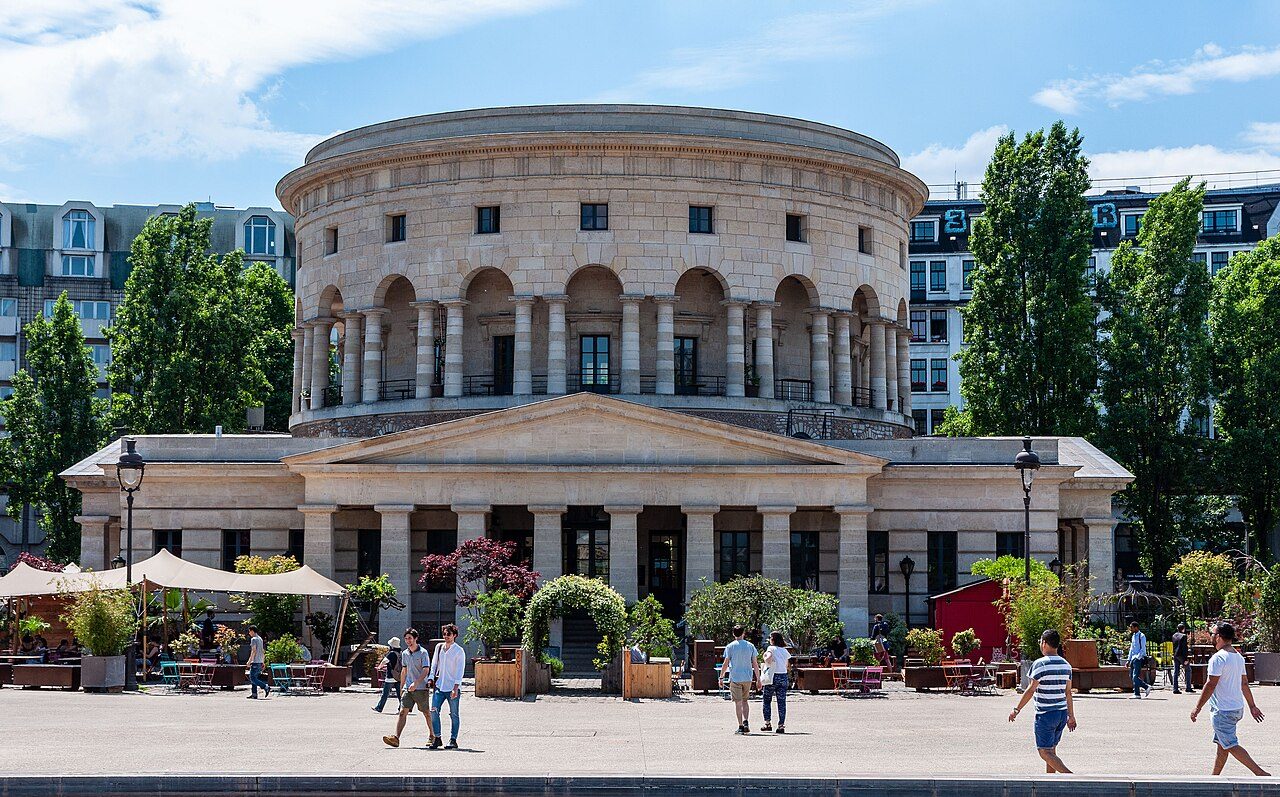
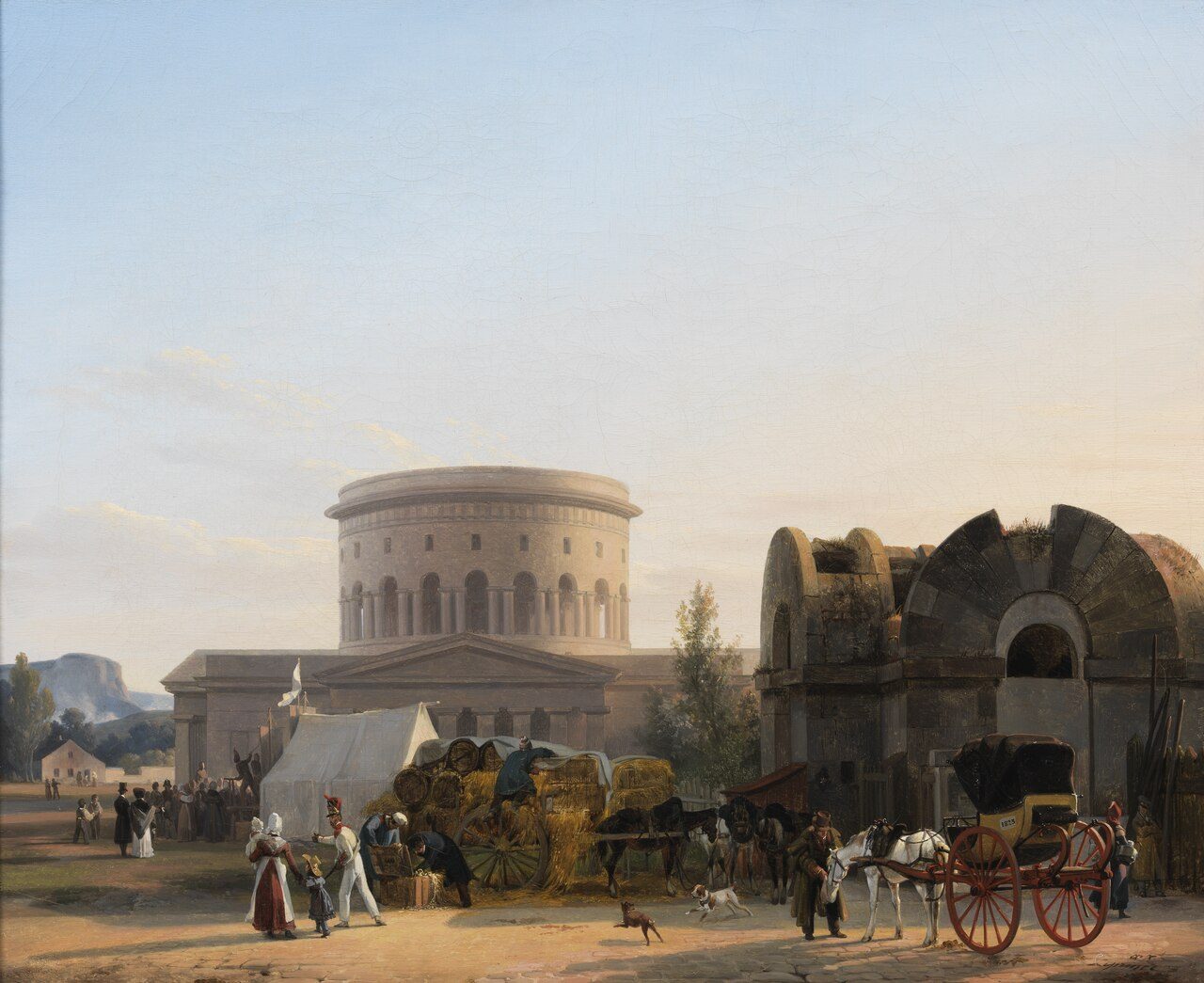
This is the grandest of them. Built between 1784 and 1788 at the northern approach to the city, it is a square block with porticoes on each side under a great drum lit by arched openings, its round inner court open to the sky. Here clerks took declarations and collected the tax. On the night of 20 to 21 June 1791, Louis XVI and his family, fleeing the Tuileries in disguise, changed carriages near this barrier at the start of the journey that ended at Varennes.
When the wall was demolished in 1860, four of Ledoux’s buildings were spared: this one, the rotunda at the gate of the parc Monceau, the two columns of the barrière du Trône and the pavilions of the barrière d’Enfer at Denfert-Rochereau. The Rotonde went on to serve as a guard barracks, a salt store and offices; it was burned during the Commune, hit in an air raid in 1918, and nearly lost again when the elevated Métro line 2 was built around it at the start of the twentieth century. Today it looks across the place de Stalingrad to the long basin of the Villette canal, and has housed a restaurant and event venue since 2009–2010.
What to look for
- The four porticoes, one on each face, with their sturdy square pillars.
- The great drum ringed with arched openings that crowns the building.
- The elevated Métro line 2, which bends around the Rotonde.
- The view north-east along the bassin de la Villette, opened in 1808.
Timeline
- 1784Construction of the Wall of the Farmers-General begins
- 1784–1788Ledoux builds the Rotonde
- 1791The royal family changes carriages here during the flight to Varennes
- 1860The wall is demolished; the Rotonde is spared
- 1871Damaged by fire during the Commune
- 1907Listed as a historic monument
Plaques within 250 m
- 6 Quai De La Seine · 180 m
Le 23 mars 1918 à 7:20 du matin le premier obus de la Bertha est tombé devant cet immeuble
Commemorative plaques, Ville de Paris open data (ODbL); transcriptions as published, in French.
Sources
- Ville de Paris: De porte en porte, Paris se raconte
- Wikipédia: Rotonde de la Villette
- Paris ZigZag: Ce monument parisien a été construit à une époque où entrer dans Paris était payant
- Paris ZigZag: Connaissez-vous le mur des Fermiers Généraux ?
- Structurae: Mur des Fermiers généraux
- Wikidata Q1240015 (coordinates, CC0)
- Base Mérimée PA00086761