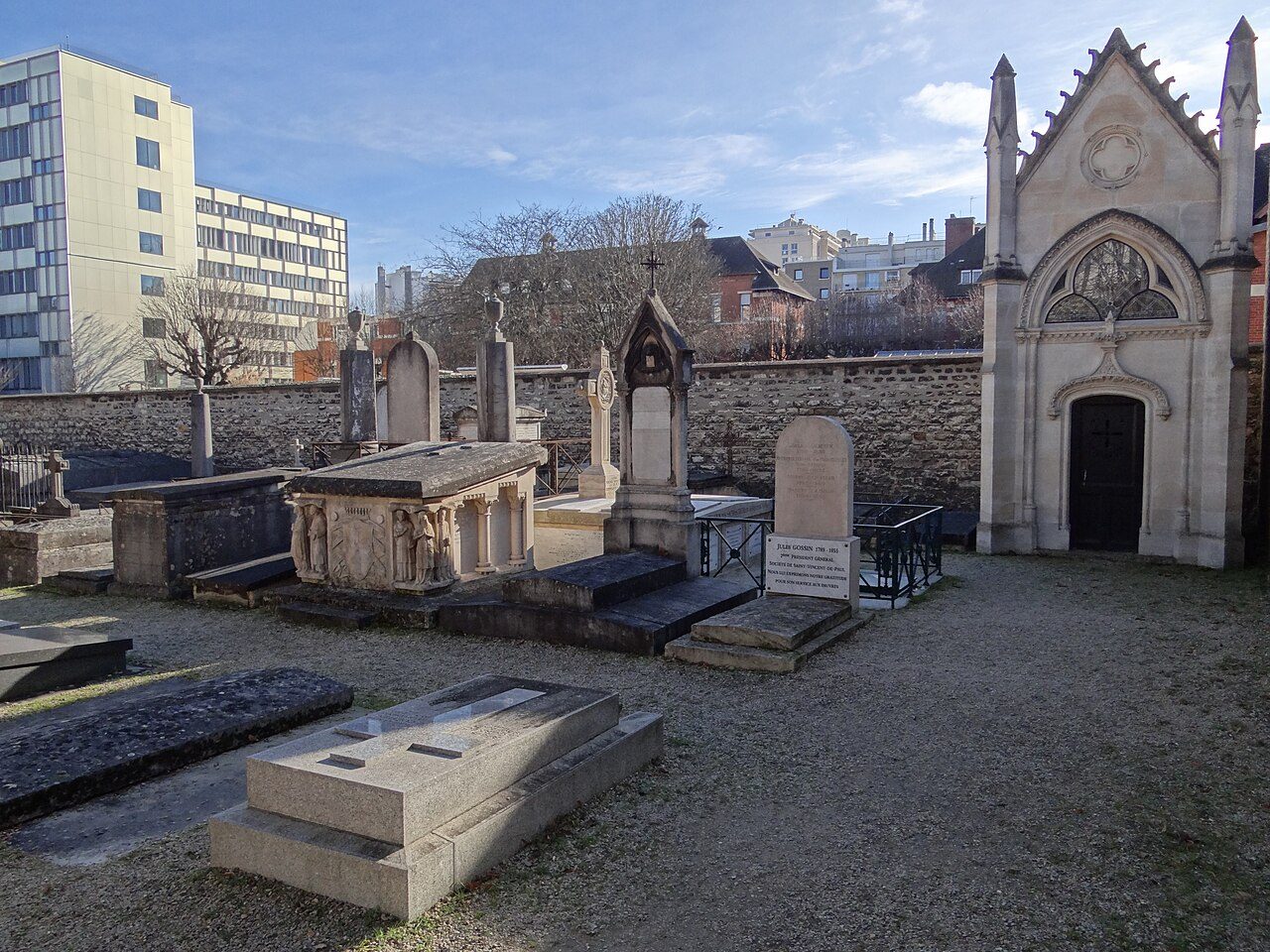
In the summer of 1794 the guillotine was moved to the eastern edge of Paris, to the barrière du Trône, renamed Trône-Renversé, now the place de la Nation. It worked there for six weeks, at the height of the Terror, sometimes taking more than fifty heads a day. The bodies needed somewhere to go. The garden of a convent of Augustinian canonesses, confiscated in 1792, lay a few hundred metres away, and two pits were dug in it. Between 14 June and 27 July 1794, the day Robespierre fell, 1,306 people were thrown into them: aristocrats and their servants, clergy, and people of every condition, the poet André Chénier, Alexandre de Beauharnais, and sixteen Carmelite nuns from Compiègne, guillotined on 17 July and canonised in 2024.
The site might have been forgotten. In 1797 Princess Amalie Zephyrine of Salm-Kyrburg, whose brother Frederick had been executed on 23 July 1794, quietly bought the plot of the pits. In 1802 families of the victims, among them the Noailles, raised a subscription to buy the rest of the garden and set up a committee to keep it. A religious community moved into the convent, and a chapel was built where the names of the dead are carved on marble plaques.
Beside the pits lies a small cemetery reserved for descendants of the victims. Its most famous grave is that of the Marquis de Lafayette, who died in 1834. His wife Adrienne, who had lost her grandmother, mother and sister to the guillotine in July 1794, was buried here in 1807, and he chose to lie beside her, under earth he had brought back from Bunker Hill.
On 4 July 1917, soon after American troops reached France, Colonel Charles E. Stanton paid tribute at the grave, the first documented occasion on which an American flag was placed there; an American flag has flown over it since, and is said to have stayed up through the German Occupation. Every 4 July an American delegation honours him. The cemetery remains private, run by a foundation, and is still the burial place for descendants of those who lie in the pits.
What to look for
- The walled enclosure of the two mass graves.
- Lafayette’s grave and the American flag above it.
- The marble plaques in the chapel listing the names of the dead.
- The family names on the tombs: Noailles, La Rochefoucauld, Montalembert, Montmorency.
Timeline
- 1792The convent of the Augustinian canonesses is confiscated
- 17941,306 victims of the guillotine buried in two pits, 14 June to 27 July
- 1797Princess Amalie Zephyrine of Salm-Kyrburg secretly buys the plot of the pits
- 1802Victims’ families buy the garden by subscription (uncertain date)
- 1834Lafayette buried beside his wife Adrienne
- 1917American tribute on 4 July; the flag over Lafayette’s grave
Plaques within 250 m
- 35 Rue De Picpus · 20 m
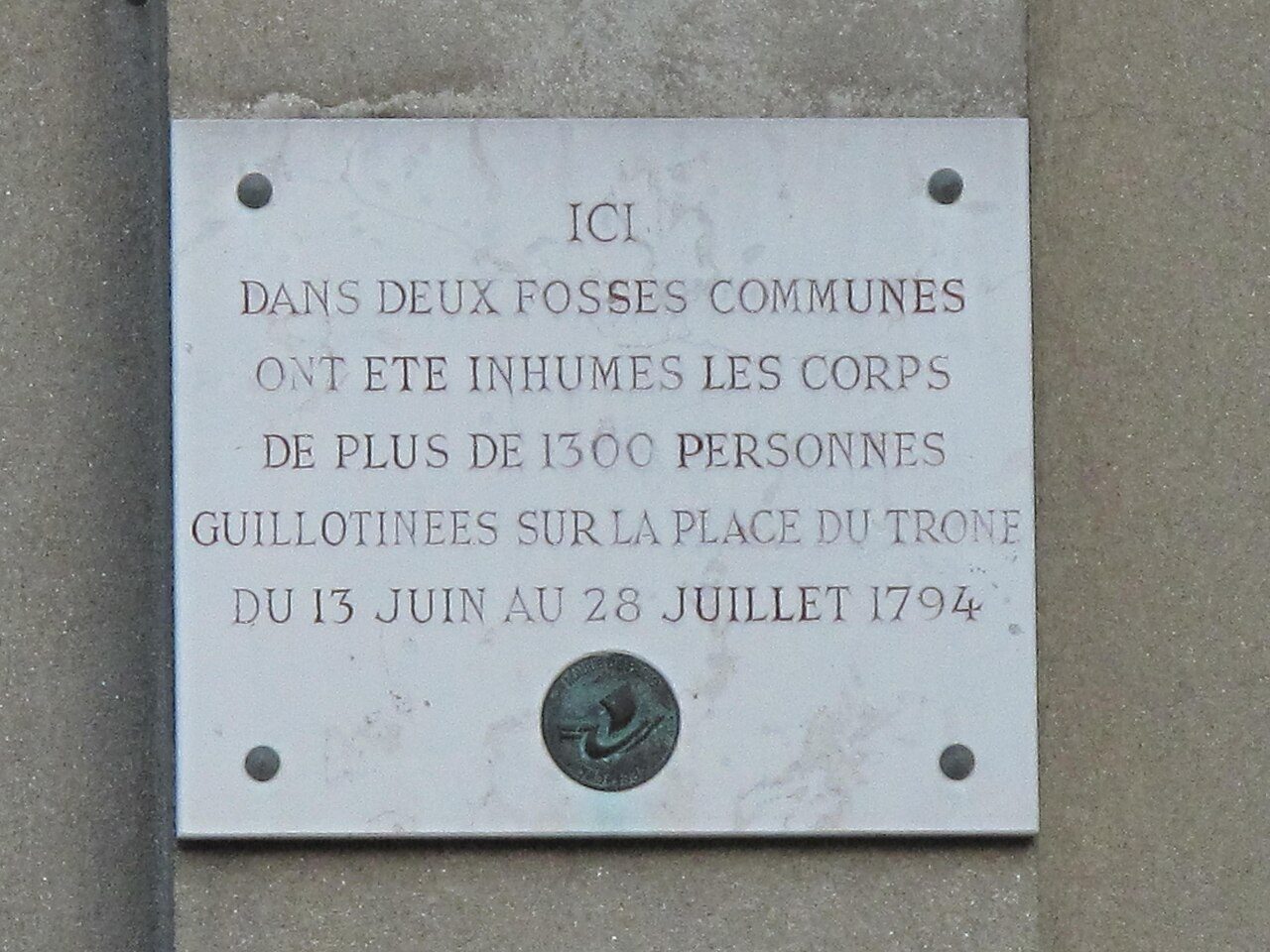
ICI / DANS DEUX FOSSES COMMUNES / ONT ETE INHUMES LES CORPS / DE PLUS DE 1300 PERSONNES / GUILLOTINEES SUR LA PLACE DU TRONE / DU 13 JUIN AU 28 JUILLET 1794
Commemorative plaques, Ville de Paris open data (ODbL); transcriptions as published, in French.
Sources
- Aleteia: Picpus, le cimetière parisien méconnu où reposent les carmélites de Compiègne
- Paris Zigzag: Le cimetière des guillotinés, un lieu d’histoire et de mémoire
- Bonjour Paris: Place de la Nation and the Picpus Cemetery
- Wikipedia: Picpus Cemetery
- Wikidata Q281477 (coordinates, CC0)
- Base Mérimée PA75120002