1840–1902
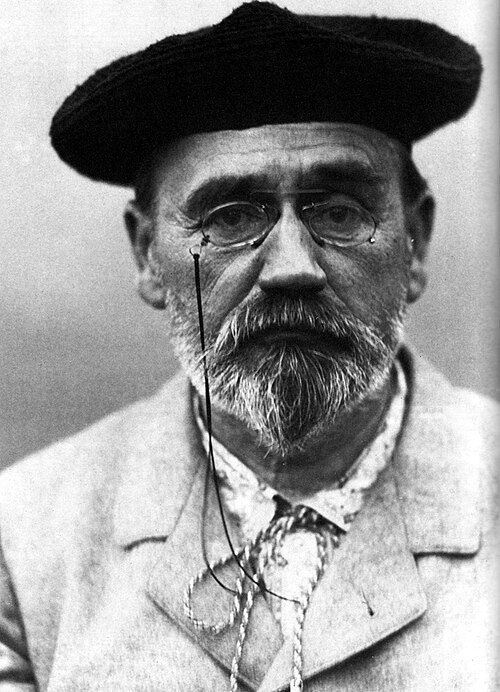
Émile Zola
The novelist of Les Halles, the department store and the zinc bar, who ended at the Panthéon after J’accuse.
Zola was born in Paris, in the rue Saint-Joseph, on 2 April 1840, grew up in Aix-en-Provence after his father’s early death, and came back to the capital with his mother, poor and determined. In 1862 he joined the publisher Hachette, rising to run its publicity department, and wrote journalism and art criticism, and defended his friends Manet and the painters who would be called Impressionists.
His twenty-novel cycle, Les Rougon-Macquart, published between 1871 and 1893, is among other things the great portrait of Haussmann’s Paris. Le Ventre de Paris takes place in the new iron pavilions of Les Halles; L’Assommoir in the working-class streets of the Goutte-d’Or; Au Bonheur des Dames inside a department store; Nana in the theatres and passages of the boulevards; L’Œuvre among painters on the quays. Zola documented each setting with notebooks and plans, and the city he describes is precise down to the smell.
Success brought a house at Médan, outside Paris, and from 1889 a large apartment on the rue de Bruxelles, below Montmartre. On 13 January 1898 L’Aurore published his open letter to the President of the Republic on the Dreyfus affair under Clemenceau’s headline, J’accuse. Convicted of libel, he spent a year in exile in London. He died in his rue de Bruxelles home on 29 September 1902, asphyxiated by fumes from the chimney; the inquiry concluded it was an accident, though many now believe the flue was blocked on purpose. His remains were moved to the Panthéon on 4 June 1908.
Elles se solidifiaient, d’un gris verdâtre, plus géantes encore, avec leur mâture prodigieuse, supportant les nappes sans fin de leurs toits. Elles entassaient leurs masses géométriques; et, quand toutes les clartés intérieures furent éteintes, qu’elles baignèrent dans le jour levant, carrées, uniformes, elles apparurent comme une machine moderne, hors de toute mesure, quelque machine à vapeur, quelque chaudière destinée à la digestion d’un peuple, gigantesque ventre de métal, boulonné, rivé, fait de bois, de verre et de fonte, d’une élégance et d’une puissance de moteur mécanique, fonctionnant là, avec la chaleur du chauffage, l’étourdissement, le branle furieux des roues.
Greenish-grey in hue, they looked more solid now, and even more colossal with their prodigious masting of columns upholding an endless expanse of roofs. They rose up in geometrically shaped masses; and when all the inner lights had been extinguished and the square uniform buildings were steeped in the rising dawn, they seemed typical of some gigantic modern machine, some engine, some caldron for the supply of a whole people, some colossal belly, bolted and riveted, built up of wood and glass and iron, and endowed with all the elegance and power of some mechanical motive appliance working there with flaring furnaces, and wild, bewildering revolutions of wheels.
✓ Quotation checked word for word against the edition cited.
Addresses
-
10 rue Saint-Joseph · 2nd · 1840
His birthplace, on 2 April 1840.
EMILE ZOLA/ EST NÉ/ DANS CETTE MAISON/ LE 2 AVRIL 1840
-
142 rue Montmartre · 2nd · 1898
Then the offices of the newspaper L’Aurore, where on 12 January 1898 Zola handed Clemenceau his open letter on the Dreyfus affair, published the next day as J’accuse.
C'EST DANS CET IMMEUBLE/ QUI ABRITAIT ALORS LES BUREAUX/ DU JOURNAL """"L'AURORE""""/ QUE LE 12 JANVIER 1898/ EMILE ZOLA/ REMIT A/ GEORGES CLEMENCEAU/ REDACTEUR EN CHEF SA LETTRE/ AU PRESIDENT DE LA REPUBLIQUE/ FELIX FAURE/ DEMONTRANT L'INNOCENCE/ D'ALFRED DREYFUS/ ET PROCLAMANT:/""""LA VERITE EST EN MARCHE/ ET RIEN NE L'ARRETERA.""""/LE TEXTE PARUT LE LENDEMAIN/ SOUS LE CELEBRE TITRE/""""J'ACCUSE""""
-
21 bis rue de Bruxelles · 9th · 1889–1902
His last Paris home, where he wrote J’accuse and died on 29 September 1902.
-
Panthéon, place du Panthéon · 5th · 1908
His remains were transferred to the Panthéon in 1908.