1821–1867
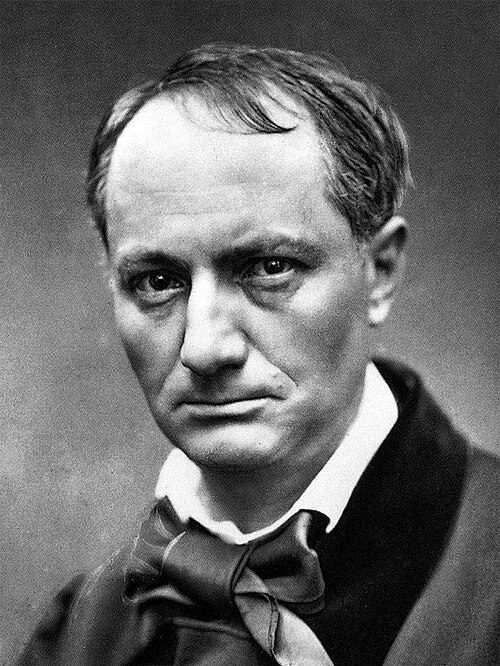
Charles Baudelaire
The poet of the modern city, who watched old Paris fall to the Second Empire’s picks and wrote its elegy.
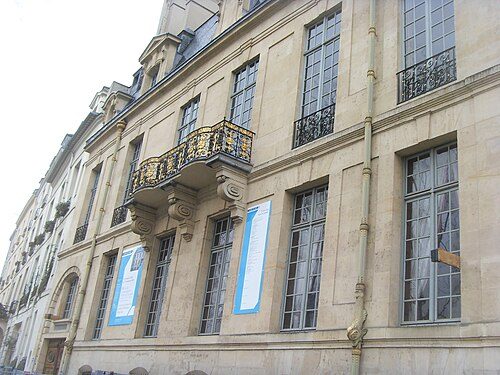
Baudelaire was born in the Latin Quarter in 1821 and spent nearly his whole life in Paris, moving from one furnished room or hotel to the next, often to escape creditors. As a young man with an inheritance to spend he lived on the Île Saint-Louis, first on the quai de Béthune, then in rooms under the roof of the Hôtel de Lauzun on the quai d’Anjou, where he dressed as a dandy, bought paintings and met the writers of the hashish club downstairs.
Les Fleurs du mal appeared in 1857 and was prosecuted for offending public morals; six poems were banned. For the second edition of 1861 Baudelaire added a new section, Tableaux parisiens, and with it invented a way of writing about the city that is still with us: crowds, gas lamps, rag-pickers, old women in the street, the passer-by glimpsed once and lost. Le Cygne, dedicated to the exiled Victor Hugo, was written as the old quarter between the Louvre and the Tuileries was being cleared to complete the palace, one of the great works of Second Empire Paris.
His prose poems, collected after his death as Le Spleen de Paris, carried the same attention into prose. Ill and in debt, he spent two unhappy years in Brussels and was brought back to Paris after a stroke in 1866. He died in a clinic in Chaillot on 31 August 1867 and is buried in the Montparnasse cemetery, in the tomb of his stepfather, General Aupick.
Andromaque, je pense à vous ! Ce petit fleuve,
Pauvre et triste miroir où jadis resplendit
L’immense majesté de vos douleurs de veuve,
Ce Simoïs menteur qui par vos pleurs grandit,
A fécondé soudain ma mémoire fertile,
Comme je traversais le nouveau Carrousel.
Le vieux Paris n’est plus (la forme d’une ville
Change plus vite, hélas ! que le cœur d’un mortel) ;
Andromache, I think of you! The stream,
The poor, sad mirror where in bygone days
Shone all the majesty of your widowed grief,
The lying Simoïs flooded by your tears,
Made all my fertile memory blossom forth
As I passed by the new-built Carrousel.
Old Paris is no more (a town, alas,
Changes more quickly than man’s heart may change);
✓ Quotation checked word for word against the edition cited.
Addresses
-
15 rue Hautefeuille · 6th · 1821
Site of the house where Baudelaire was born on 9 April 1821; the building has gone.
Charles BAUDELAIRE/En ce lieu s'élevait la maison/où naquit le poète Charles Baudelaire/le 9 avril 1821
-
22 quai de Béthune · 4th · 1842–1843
His first lodging on the Île Saint-Louis, in the years he spent his inheritance as a dandy.
HOTEL/LEFEBVRE DE LA MALMAISON/Conseiller au Parlement/1645/BAUDELAIRE Y VECUT/en 1842 et 1843
-
17 quai d’Anjou, Hôtel de Lauzun · 4th · 1843–1845
Rooms under the roof of the Hôtel de Lauzun, where the Club des Haschischins met at the painter Fernand Boissard’s. → Hôtel de Lauzun
-
19 quai Voltaire · 7th · 1856–1858
The Hôtel du Quai Voltaire, where he lived in the years around the first edition of Les Fleurs du mal.
ICI/CHARLES BAUDELAIRE/JEAN SIBELIUS/RICHARD WAGNER/OSCAR WILDE/ONT HONORE PARIS/DE LEUR SEJOVR
-
1 rue du Dôme · 16th · 1866–1867
Dr Duval’s clinic in Chaillot, where he spent his last months after a stroke and died on 31 August 1867.
LE POETE CHARLES BAUDELAIRE / 9 avril 1821 - 31 août 1867 / a vécu, ici, ses derniers jours
-
Cimetière du Montparnasse, 6th division · 14th · 1867
His grave, in the tomb of his stepfather General Aupick; a separate cenotaph was put up in the cemetery in 1902.