1802–1885
Victor Hugo
The poet who made a cathedral famous and a city epic, and whose coffin crossed Paris to the Panthéon.
Hugo was born in Besançon, but Paris made him and he, in turn, made a Paris that readers still walk through. As a boy he played in the overgrown garden of the old Feuillantines convent near the Val-de-Grâce, a wilderness he remembered all his life. As a young man he lived on the Left Bank streets around Saint-Sulpice and the rue Notre-Dame-des-Champs, where he wrote Hernani, the play whose first night in 1830 became a battle between Romantics and classicists.
Notre-Dame de Paris, published in 1831, did something few novels have done: it changed the fate of a building. Hugo set his story in 1482 and spent whole chapters on the cathedral and on the medieval city seen from its towers, protesting against the neglect and clumsy alterations of his own day. The book helped turn opinion towards the restoration that Lassus and Viollet-le-Duc carried out from the 1840s.
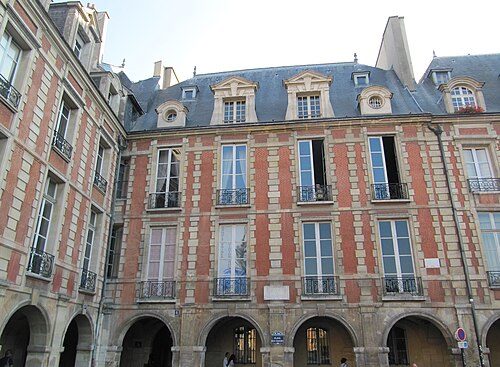
From 1832 to 1848 he lived on the place Royale, now the place des Vosges, at the height of his fame. Exile under Napoleon III kept him away from 1851 to 1870, and it was from Guernsey that he finished Les Misérables, a novel of Paris streets, barricades and sewers, published in 1862. He came back after the fall of the Empire, lived his last years on the avenue that already bore his name, and died there on 22 May 1885. His body lay in state beneath the Arc de Triomphe before being carried to the Panthéon on 1 June.
Paris est né, comme on sait, dans cette vieille île de la Cité qui a la forme d’un berceau. La grève de cette île fut sa première enceinte, la Seine son premier fossé. Paris demeura plusieurs siècles à l’état d’île, avec deux ponts, l’un au nord, l’autre au midi, et deux têtes de pont, qui étaient à la fois ses portes et ses forteresses, le Grand-Châtelet sur la rive droite, le Petit-Châtelet sur la rive gauche.
Paris had its birth, as the reader knows, in that old island of the City which has the form of a cradle. The strand of that island was its first boundary wall, the Seine its first moat. Paris remained for many centuries in its island state, with two bridges, one on the north, the other on the south; and two bridge heads, which were at the same time its gates and its fortresses,—the Grand-Châtelet on the right bank, the Petit-Châtelet on the left.
✓ Quotation checked word for word against the edition cited.
Car Paris est un total. Paris est le plafond du genre humain. Toute cette prodigieuse ville est un raccourci des moeurs mortes et des moeurs vivantes. Qui voit Paris croit voir le dessous de toute l’histoire avec du ciel et des constellations dans les intervalles.
For Paris is a total. Paris is the ceiling of the human race. The whole of this prodigious city is a foreshortening of dead manners and living manners. He who sees Paris thinks he sees the bottom of all history with heaven and constellations in the intervals.
✓ Quotation checked word for word against the edition cited.
Addresses
-
Site of the former Feuillantines convent, rue des Feuillantines · 5th · 1808–1813
Hugo spent part of his childhood in buildings of the former convent of the Feuillantines and remembered its wild garden in his poems.
VICTOR HUGO / A PASSE UNE PARTIE DE SON ENFANCE / DE 1808 A 1813 / DANS LES BATIMENTS / DE L'ANCIEN COUVENT DES FEUILLANTINES / QUI OCCUPAIT CET EMPLACEMENT / [EN BAS A DROITE] 1912
-
9 rue Jean-Goujon · 8th · c. 1830–1832
The house where, according to the City of Paris, Hugo wrote Notre-Dame de Paris.
-
6 place des Vosges · 4th · 1832–1848
Hugo’s apartment on the second floor of the Hôtel de Rohan-Guéménée for sixteen years; now the Maison de Victor Hugo. → Maison de Victor Hugo
VICTOR HUGO / HABITA DANS CET HOTEL / DE 1833 À 1848
-
124 avenue Victor-Hugo (then avenue d’Eylau) · 16th · until 1885
Site of the house where Hugo spent his last years and died on 22 May 1885; the building has gone.
ICI S'ELEVAIT L'HOTEL / OU VICTOR HUGO EST MORT / LE 22 MAI 1885
-
Panthéon, place du Panthéon · 5th · 1885
Hugo’s coffin was carried here on 1 June 1885 after a national funeral; he lies in the crypt.