
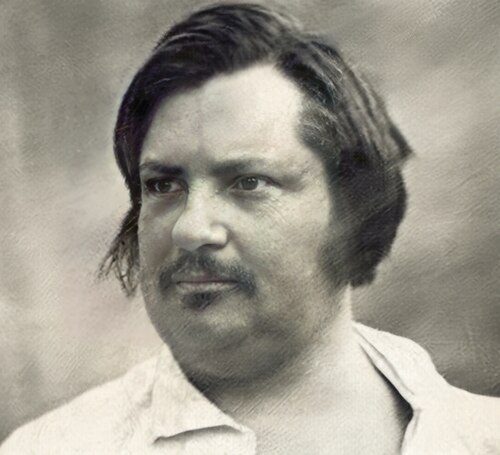

1799–1850
Honoré de Balzac
The novelist who treated Paris as a living organism, street by street, and hid from his creditors in Passy.
Balzac came to Paris from Tours as a boy, when his family settled in the Marais, and he never really left it, even in his books set in the provinces. At twenty he shut himself in an attic on the rue de Lesdiguières, near the Arsenal, to become a writer, and turned out melodramas and cheap novels under pseudonyms. A printing business on the rue des Marais-Saint-Germain, now the rue Visconti, ended in debt in 1828, and debt followed him for the rest of his life.
What he learned in those years became La Comédie humaine, the vast cycle in which Paris is the main character. Balzac knew what a room cost in each quarter, how a boarding house near the Panthéon smelled, which streets were respectable and which were not. Le Père Goriot, Illusions perdues, Splendeurs et misères des courtisanes and César Birotteau read today as maps of a city of ambition and money in the 1820s and 1830s, before Haussmann’s boulevards.
From 1840 to 1847 he lived under a borrowed name in a garden flat in Passy, today the Maison de Balzac, revising the whole Comédie humaine. In 1846 he bought a house on the rue Fortunée, near the faubourg du Roule, for Ewelina Hańska, whom he married in March 1850. He died there that August, and the street was renamed after him.
Il est dans Paris certaines rues déshonorées autant que peut l’être un homme coupable d’infamie; puis il existe des rues nobles, puis des rues simplement honnêtes, puis de jeunes rues sur la moralité desquelles le public ne s’est pas encore formé d’opinion; puis des rues assassines, des rues plus vieilles que de vieilles douairières ne sont vieilles, des rues estimables, des rues toujours propres, des rues toujours sales, des rues ouvrières, travailleuses, mercantiles. Enfin, les rues de Paris ont des qualités humaines, et nous impriment par leur physionomie certaines idées contre lesquelles nous sommes sans défense.
Certain streets in Paris are as degraded as a man covered with infamy; also, there are noble streets, streets simply respectable, young streets on the morality of which the public has not yet formed an opinion; also cut-throat streets, streets older than the age of the oldest dowagers, estimable streets, streets always clean, streets always dirty, working, laboring, and mercantile streets. In short, the streets of Paris have every human quality, and impress us, by what we must call their physiognomy, with certain ideas against which we are defenceless.
✓ Quotation checked word for word against the edition cited.
Si vous vous promenez dans les rues de l’île Saint-Louis, ne demandez raison de la tristesse nerveuse qui s’empare de vous qu’à la solitude, à l’air morne des maisons et des grands hôtels déserts. Cette île, le cadavre des fermiers-généraux, est comme la Venise de Paris.
If you walk the streets of the Ile Saint-Louis, do not seek the reason of the nervous sadness that lays hold upon you save in the solitude of the spot, the gloomy look of the houses, and the great deserted mansions. This island, the ghost of _fermiers-generaux_, is the Venice of Paris.
✓ Quotation checked word for word against the edition cited.
Addresses
-
9 rue de Lesdiguières · 4th · 1819
The attic where the young Balzac shut himself away to write, producing early work under the pseudonym Lord R’Hoone.
-
17 rue Visconti (then rue des Marais-Saint-Germain) · 6th · 1826–1828
Balzac’s printing works, which failed and left him with debts that pursued him all his life.
DANS CETTE MAISON / BALZAC / AUTEUR DE LA COMÉDIE HUMAINE / ÉTABLIT SON IMPRIMERIE 1826 -1828 / 1930
-
47 rue Raynouard · 16th · 1840–1847
The garden flat in Passy where he lived under the name of Monsieur de Breugnol and revised La Comédie humaine; now the Maison de Balzac. → Maison de Balzac
-
Rue Balzac (then rue Fortunée) · 8th · 1846–1850
Site of the house he bought for Ewelina Hańska and where he died on 18 August 1850; the house has gone and the street now bears his name.
In this guide
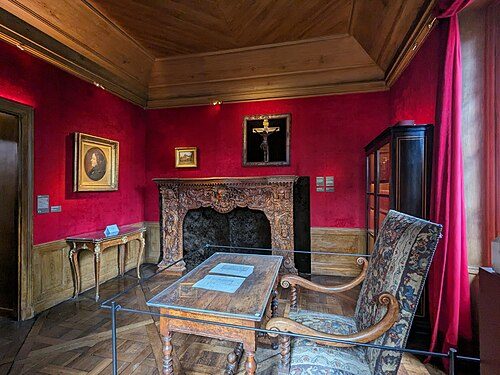 Writers’ houses · 16th
Maison de Balzac
The garden flat in Passy where Balzac hid from his creditors under a borrowed name, with a back way out down to the rue Berton.
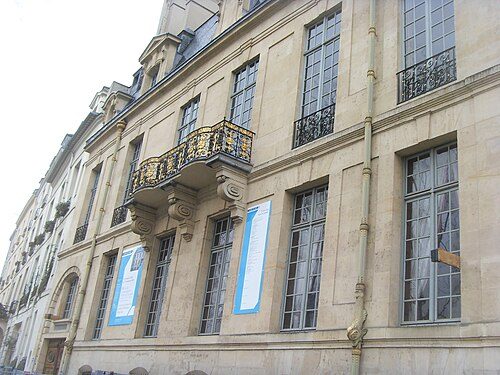 Writers’ houses · 4th
Hôtel de Lauzun
A gilded 1650s mansion on the Île Saint-Louis, where the young Baudelaire rented the attic and Gautier’s hashish eaters met.
Sources
- Ville de Paris: Une balade sur les pas d’Honoré de Balzac
- Maison de Balzac: Hôtel de Balzac, rue Fortunée (now rue Balzac)
- Archives nationales: rue Balzac (référentiel des lieux)
- Paris Zigzag: Sur les traces de Balzac à Paris
- Dartmouth Library: Katharine Prescott Wormeley papers (Roberts Brothers correspondence)