
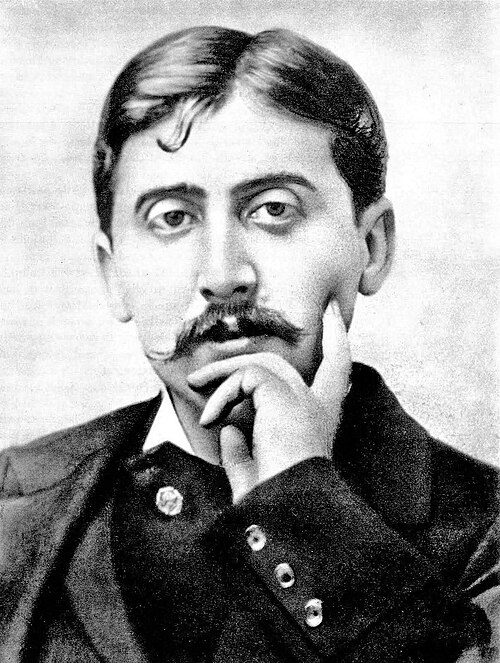

1871–1922
Marcel Proust
The novelist of the Champs-Élysées gardens and the Bois de Boulogne, who wrote his great book in a cork-lined room.
Proust was born on 10 July 1871 in Auteuil, then a village on the western edge of Paris, in the house of his mother’s family, and grew up in the bourgeois comfort of the boulevard Malesherbes, near the Madeleine. He belonged to the Paris of the Plaine Monceau and the new quarters of the eighth arrondissement, the Lycée Condorcet, the salons of Madame Arman de Caillavet and Madeleine Lemaire, and dinners at the Ritz.
That Paris became the world of À la recherche du temps perdu. The narrator plays as a child in the gardens of the Champs-Élysées, where he falls in love with Gilberte; he watches Odette Swann pass in her carriage in the Bois de Boulogne; he climbs the social ladder from the Verdurins’ bourgeois drawing room to the Guermantes’ town house. Proust is also the great writer of how places change and fail us: the Bois at the end of Du côté de chez Swann is no longer the Bois he remembered.
After his parents’ deaths, Proust moved in December 1906 to the second floor of 102 boulevard Haussmann, a building owned by his family. There, in the bedroom he had lined with cork against noise and dust, he wrote most of the novel, sleeping by day and working by night. The building was sold in 1919; after a short stay elsewhere he moved to the rue Hamelin, where he died on 18 November 1922. He is buried in the Père-Lachaise cemetery.
La réalité que j’avais connue n’existait plus. Il suffisait que Mme Swann n’arrivât pas toute pareille au même moment, pour que l’Avenue fût autre. Les lieux que nous avons connus n’appartiennent pas qu’au monde de l’espace où nous les situons pour plus de facilité. Ils n’étaient qu’une mince tranche au milieu d’impressions contiguës qui formaient notre vie d’alors; le souvenir d’une certaine image n’est que le regret d’un certain instant; et les maisons, les routes, les avenues, sont fugitives, hélas, comme les années.
The reality that I had known no longer existed. It sufficed that Mme. Swann did not appear, in the same attire and at the same moment, for the whole avenue to be altered. The places that we have known belong now only to the little world of space on which we map them for our own convenience. None of them was ever more than a thin slice, held between the contiguous impressions that composed our life at that time; remembrance of a particular form is but regret for a particular moment; and houses, roads, avenues are as fugitive, alas, as the years.
✓ Quotation checked word for word against the edition cited.
Addresses
-
96 rue La Fontaine · 16th · 1871
Site of his great-uncle’s house in Auteuil, where Proust was born on 10 July 1871.
-
9 boulevard Malesherbes · 8th · until 1900
The family apartment where he grew up.
-
45 rue de Courcelles · 8th · 1900–1906
The family’s apartment from 1900; Proust stayed on after his father’s death in 1903 and his mother’s in 1905.
MARCEL PROUST / 1871-1922 / DEMEURA DANS CET IMMEUBLE / DE 1900 A 1906
-
102 boulevard Haussmann · 8th · 1906–1919
His second-floor apartment and cork-lined bedroom, where he wrote most of À la recherche du temps perdu.
-
44 rue Hamelin · 16th · 1919–1922
His last apartment, where he died on 18 November 1922.
-
Cimetière du Père-Lachaise, 85th division · 20th · 1922
His grave.