
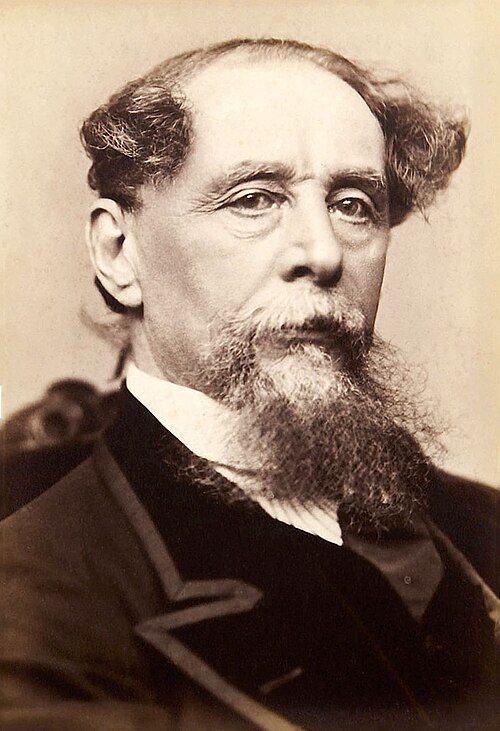

1812–1870
Charles Dickens
The Londoner who wintered in Paris, haunted its Morgue, and put the faubourg Saint-Antoine at the heart of A Tale of Two Cities.
Dickens was a Londoner to the bone, but Paris fascinated him. He first passed through in 1844 on his way to Italy, and came back for long stays: in the winter of 1846–47 he rented a house on the rue de Courcelles, and in 1855–56 he took an apartment on the Champs-Élysées for his family. He went often to the theatre, met French writers, Victor Hugo among them, and walked the city as tirelessly as he walked London.
He was also drawn, by what he called an invisible force, to the Paris Morgue, then a small building on the river by Notre-Dame where the unidentified dead were laid out behind glass for the public to see. He wrote about it, and about the vast clearances of the Île de la Cité under the Second Empire, in the essays later collected as The Uncommercial Traveller.
A Tale of Two Cities, serialised in 1859, is his Paris novel, though he set it in the Revolution rather than his own time. Its French scenes centre on the faubourg Saint-Antoine, the working quarter east of the Bastille, and on the wine shop of the Defarges, where a broken cask of red wine in the street becomes an omen of the blood to come. A French translation by Henriette Loreau, Paris et Londres en 1793, was published by Hachette in 1861. Dickens returned to Paris in 1863 to give public readings, which he described as an enormous success.
The wine was red wine, and had stained the ground of the narrow street in the suburb of Saint Antoine, in Paris, where it was spilled. It had stained many hands, too, and many faces, and many naked feet, and many wooden shoes. The hands of the man who sawed the wood, left red marks on the billets; and the forehead of the woman who nursed her baby, was stained with the stain of the old rag she wound about her head again.
C’était du vin rouge qui avait coulé dans cette rue obscure du faubourg Saint-Antoine, et qui avait taché les pavés, taché ces mains, ces visages, ces pieds nus. Le scieur de bois laissait des marques rouges sur les bûches qu’il prenait. La femme, qui allaitait son enfant, portait au front des taches rouges que lui avaient faites le haillon replacé autour de sa tête.
✓ Quotation checked word for word against the edition cited.
That is to say, Notre-Dame was before me, but there was a large open space between us. A very little while gone, I had left that space covered with buildings densely crowded; and now it was cleared for some new wonder in the way of public Street, Place, Garden, Fountain, or all four. Only the obscene little Morgue, slinking on the brink of the river and soon to come down, was left there, looking mortally ashamed of itself, and supremely wicked.
✓ Quotation checked word for word against the edition cited.
Addresses
-
48 rue de Courcelles · 8th · 1846–1847
The house Dickens rented for the winter of 1846–47; several of his letters are headed from this address.
-
49 avenue des Champs-Élysées · 8th · 1855–1856
The apartment he took for his family in 1855–56, from which he wrote to his friends Wilkie Collins and Mark Lemon.
-
Hôtel du Helder, rue du Helder · 9th · 1863
His hotel during the stay of January and February 1863, when he gave public readings in Paris.
Sources
- The Morgan Library & Museum: Dickens letter from 48 rue de Courcelles, 12 January 1847
- Free Library of Philadelphia: Dickens letter to Lady Blessington, 27 January 1847
- Free Library of Philadelphia: Dickens letter to Mark Lemon, 49 avenue des Champs-Élysées
- The Charles Dickens Letters Project: Hôtel du Helder, 1863
- BnF catalogue: Paris et Londres en 1793, trad. Henriette Loreau (Hachette, 1861)
- France Today: Dickens in Paris, a Tale of Two Cities